


Why PEMDAS Is the Foundation of Every Math Problem You’ll Ever Solve
PEMDAS is the standard order of operations used in mathematics to determine which calculations to perform first in any expression.
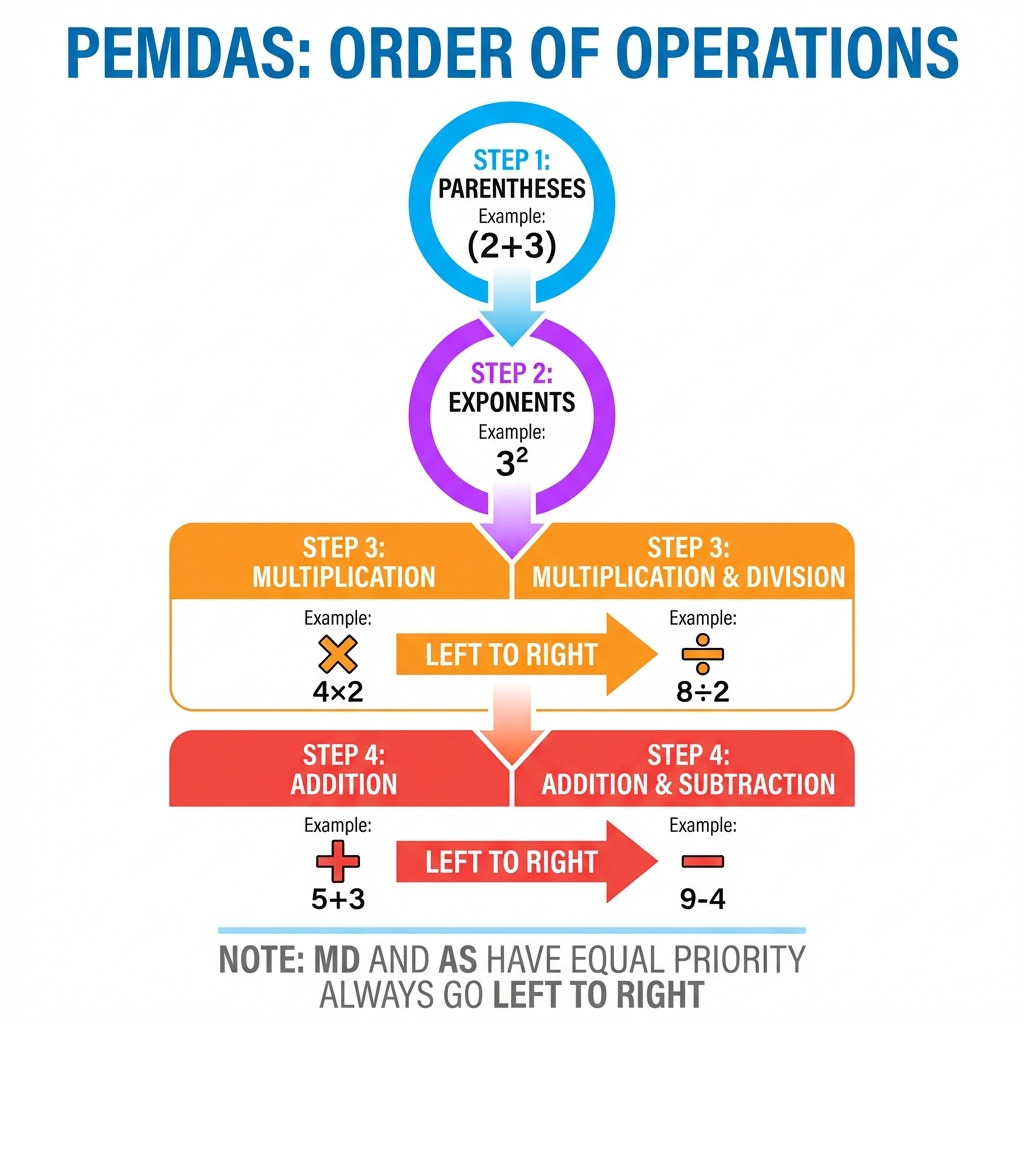
Quick answer — PEMDAS stands for:
- P – Parentheses
- E – Exponents
- M – Multiplication
- D – Division
- A – Addition
- S – Subtraction
Important: Multiplication and division have equal priority and are solved left to right. Same goes for addition and subtraction.
So for something like 1 + 2 × 3, the answer is 7 — not 9. You multiply first, then add.
Without a shared set of rules, two people solving the same problem could get two completely different answers. PEMDAS exists so that doesn’t happen.
The rules were informally agreed upon as far back as the 1500s and formally standardized in the early 1900s. Today, the same logic is baked into calculators, spreadsheet software, and programming languages around the world.
You may also know it as “Please Excuse My Dear Aunt Sally” — a memory trick that’s helped generations of students keep the order straight.
At Edible Brooklyn, we know that the right order of operations is just as important in the kitchen as it is in the classroom. Explore some of our favorite precisely-measured recipes:
What is PEMDAS?

At its heart, pemdas is more than just a word; it is a protocol. In New York, whether we are calculating the tip on a large dinner bill in Manhattan, measuring out ingredients for a sourdough starter in New Paltz, or calculating the perfect smoke time for a brisket in the Catskills, we rely on consistent systems. In mathematics, that system is the Order of Operations.
The acronym serves as a roadmap for simplifying complex expressions. Let’s break down the components of the pemdas rule:
- Parentheses (P): These are the ultimate “VIPs” of math. Anything inside parentheses, brackets
[], or braces{}gets handled first. They are used to group parts of an expression together and override the standard order. - Exponents (E): This includes powers (like $3^2$) and roots (like $\sqrt{16}$). Once the parentheses are cleared, we look for these “little numbers” pressed against the upper right-hand corner of larger numbers.
- Multiplication (M) and Division (D): These two operations are siblings. They have the same level of importance.
- Addition (A) and Subtraction (S): These are the final steps, also sharing equal priority.
To help us remember this sequence, we often use mnemonic devices. The most famous is “Please Excuse My Dear Aunt Sally,” but as we’ve seen in our research, students have gotten creative over the years with phrases like “Pudgy Elves May Demand A Snack” or “Popcorn Every Monday Donuts Always Sunday.”
Using The Order of Operations correctly ensures that if we give the same equation to ten different people, they all come back with the same result. It’s about mathematical literacy and preventing the “John vs. Bob” scenarios where one person adds before multiplying and ends up with a wildly incorrect answer.
The Hierarchy of Operations and Equal Priority
One of the biggest “aha!” moments in math happens when we realize that pemdas isn’t a strict six-step ladder. It’s actually a four-step process. This is where many of us get tripped up. We see “M” before “D” in the acronym and assume multiplication always comes first. This is a myth!
In reality, Multiplication and Division are at the same precedence level. The same applies to Addition and Subtraction. When you encounter both in a row, you must work from left to right, much like reading a sentence in a book.
Multiplication and Division in PEMDAS
Think of Multiplication and Division as two sides of the same coin. Mathematically, division is just multiplication by a reciprocal. Because they are so closely related, they share the third rank in our hierarchy.
If you have an expression like 12 ÷ 6 × 3 ÷ 2, you don’t do all the multiplication first. You follow the “Left-to-Right” rule:
12 ÷ 6 = 22 × 3 = 66 ÷ 2 = 3
If you had mistakenly multiplied 6 × 3 first, you would have ended up with 12 ÷ 18, which is definitely not 3!
According to Historical Caveats on formalization, these rules weren’t just made up overnight. They evolved as mathematical notation became more sophisticated. Mathematicians informally agreed on these priorities as far back as the 1500s because they made algebraic expressions easier to write without needing a million sets of parentheses.
Addition and Subtraction in PEMDAS
Just like their cousins above, Addition and Subtraction are inverse operations. Subtraction is essentially adding a negative number. They sit together at the bottom of the hierarchy.
Once you have cleared the parentheses, exponents, and all multiplication/division, you handle the remaining plus and minus signs from left to right.
- Example:
10 - 3 + 2 - Correct (Left to Right):
10 - 3 = 7, then7 + 2 = 9. - Incorrect (A before S):
3 + 2 = 5, then10 - 5 = 5.
As we can see, ignoring the left-to-right rule can lead to significant errors, even in “simple” arithmetic.
Common Misconceptions and Ambiguities
Even with pemdas, math can occasionally feel like a “choose your own adventure” novel. This usually happens because of ambiguous notation. The internet loves to argue over problems like 6 ÷ 2(1 + 2).
Is the answer 9 or 1?
- The Case for 9: Following strict pemdas, you do the parentheses first
(1 + 2 = 3). Then you have6 ÷ 2 × 3. Working left to right,6 ÷ 2 = 3, and3 × 3 = 9. - The Case for 1: Some older textbooks and specific academic conventions suggest that “implied multiplication” (multiplication by juxtaposition, where there is no
×symbol) should take higher priority. In this view, you treat2(3)as a single unit, giving you6 ÷ 6 = 1.
Most modern calculators and the American Mathematical Society would lean toward 9, but the very existence of the debate shows why we need to be careful. In professional settings—like writing a recipe for a massive catering event in Brooklyn—we avoid this ambiguity by using clear grouping symbols or fraction bars.
There is also a valid Critique of PEMDAS mnemonics that suggests these acronyms can actually hinder deep understanding. By focusing on a “catchy phrase,” students sometimes forget the underlying logic of why exponents come before addition (exponents are repeated multiplication, which is “stronger” than addition).
Global Variations: BODMAS, BEDMAS, and GEMS
If you travel outside the United States, you might hear different names for the same rules. While we use pemdas in New York and across the US, our friends in the UK, India, and Australia often use BODMAS.
- BODMAS: Brackets, Orders, Division, Multiplication, Addition, Subtraction.
- BEDMAS: Brackets, Exponents, Division, Multiplication, Addition, Subtraction (common in Canada).
- BIDMAS: Brackets, Indices, Division, Multiplication, Addition, Subtraction.
Interestingly, there is a bit of a mystery regarding BODMAS etymology. While “Orders” refers to exponents, nobody is quite sure why that specific word was chosen. It’s one of those quirks of history that has stuck around for decades.
A more modern alternative gaining traction in schools is GEMS:
- G – Grouping Symbols (Parentheses, Brackets, Fraction bars)
- E – Exponents
- M – Multiplication and Division
- S – Subtraction and Addition
The benefit of GEMS is that it explicitly groups MD and AS together, reducing the chance that a student thinks they must multiply before they divide.
PEMDAS in Technology and Programming
In our digital age, the order of operations isn’t just for pencil and paper. It is the logic that powers every spreadsheet we use to track business expenses for a Manhattan restaurant or a Brooklyn craft brewery, and every line of code in our favorite apps.
Excel and Spreadsheets
If you’ve ever written a formula in Excel, you’ve used pemdas. Microsoft Excel follows a very specific Calculation operators and precedence in Excel guide. For instance, Excel handles the negation sign (like in -3^2) in a way that sometimes surprises people. In Excel, -3^2 results in 9 because it squares the negative three. In many other systems, it would result in -9 (it squares the three first, then applies the negative).
Programming Languages
Languages like Python, Java, and C++ all have “Operator Precedence” tables. Generally, they follow the standard mathematical rules:
- Parentheses always win.
- Exponents (written as
**in Python) come next. - Multiplication and division are equal and processed left to right.
- Addition and subtraction are the final step.
One interesting “glitch” in the matrix is how different tools handle “serial exponentiation” (like $4^{3^2}$). Excel might give you one answer, while a high-end tool like Wolfram Alpha gives you another. This is why software developers spend so much time using parentheses—it’s the only way to be 100% sure the computer does exactly what you want.
Frequently Asked Questions about Order of Operations
Does multiplication always come before division?
No! This is perhaps the most common mistake made by students and adults alike. Multiplication and Division have equal priority. You should perform whichever one appears first as you read the expression from left to right. If division is on the left, you divide first.
What happens if I ignore the order of operations?
If you ignore the order of operations, your results will be inconsistent and likely incorrect. For example, in the expression 5 + 2 × 10, ignoring pemdas might lead you to add 5 + 2 first, giving you 7 × 10 = 70. However, the correct mathematical answer is 5 + 20 = 25. In fields like engineering, medicine, or even high-stakes culinary measurements, these errors can have serious real-world consequences.
Why do different calculators give different answers for the same problem?
This usually happens with “implied multiplication” or ambiguous division. Some older scientific calculators were programmed with a “juxtaposition” rule that gives implied multiplication higher priority. Newer graphing calculators (like the TI-84 Plus) generally follow strict left-to-right rules. To avoid this, always use explicit parentheses when typing complex problems into a device.
Conclusion
Whether you are a student in New Paltz, a chef in the Catskills, or a local business owner in Brooklyn balancing the books, understanding pemdas is essential. It is the “grammar” of mathematics—the rules that allow us to communicate clearly and solve problems accurately.
At Edible Brooklyn, we believe that precision and culture go hand-in-hand. Just as there is an “order of operations” to creating the perfect New York bagel or a complex cocktail in a Manhattan lounge, there is a beautiful logic to the way numbers work together. By mastering these rules, we ensure that our calculations are as solid as the foundations of the Brooklyn Bridge.
Ready to put your math skills aside and treat yourself to something delicious? Explore Brooklyn’s best restaurants and see how the borough’s top chefs use their own “order of operations” to create unforgettable dining experiences. After all, once you’ve solved for X, the best reward is a great meal!
