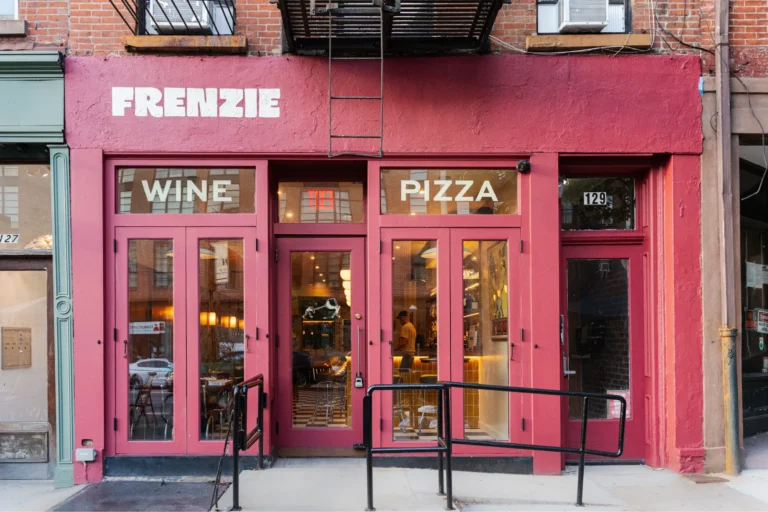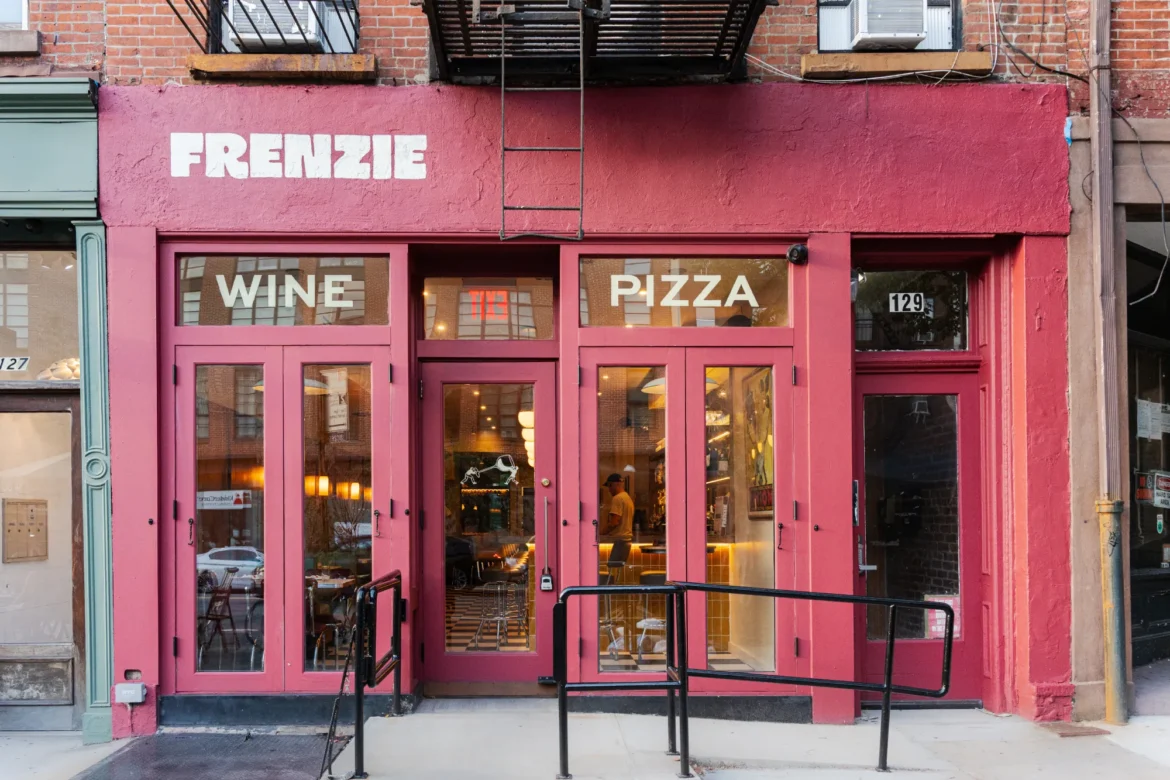
“When I want a classic slice,” Daniel Grossman tells me, “Joe’s Pizza is just…it’s perfect.” We’re sitting at Frenzie, the late-night pizzeria and wine bar he opened with Brendan Kelley in August on Atlantic Avenue in Brooklyn Heights. The afternoon sun fills the space with a nostalgic haze that makes me think of slices served on grease-soaked paper plates at L&B Spumoni Gardens. Grossman smiles. The L’Industrie alum, who met Kelley working at Roberta’s, has no gripe with someone like me, an Italian-American from a Bensonhurst family that gets agita thinking about hot honey or truffle oil on a pizza.
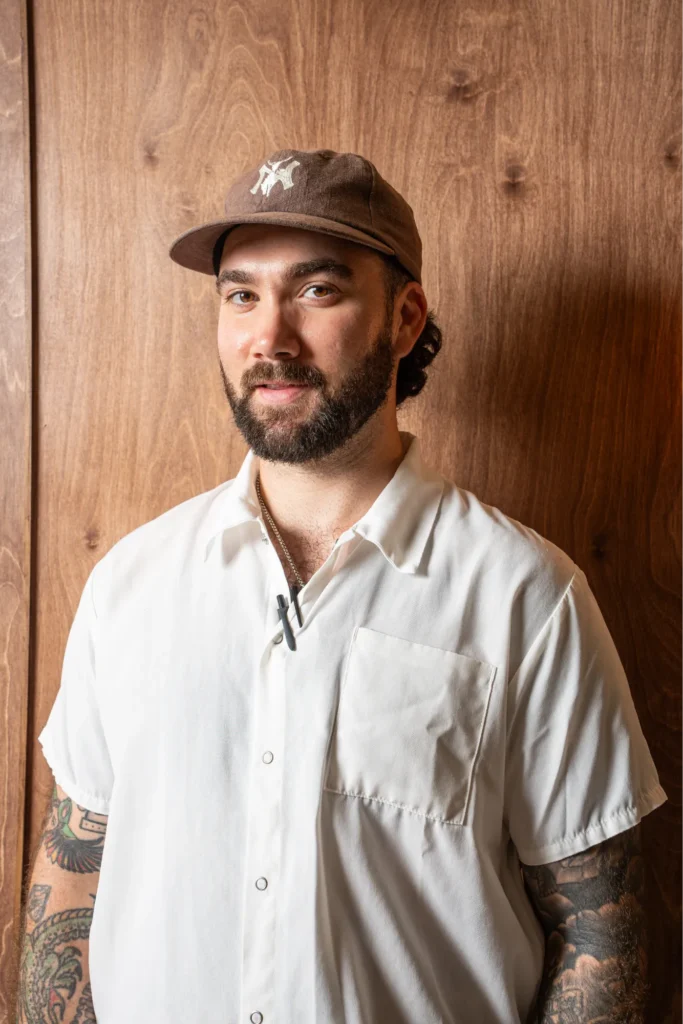


“Pizza is one of the most divisive foods, probably in the world, but especially in New York,” Grossman says. “I love when people come in and tell us Frenzie isn’t old-school.”
Artisanal Pizza Revolution
In 2004, New Jerseyan Anthony Mangieri crossed the Hudson to bring wood-fired pies to the East Village with Una Pizza Napoletana, ushering in an artisanal pizza revolution—and backlash. Generational locals fiercely defended the singular slice, which first appeared in the 1940s courtesy of gas deck ovens that created a dry, sturdy crust, perfect for eating on the go.

Many corners of the city felt there was no need to reinvent the wheel. But it seems incorrect to say the new wave pizzerias were reinventing. Before the gas deck ovens, coal-fired pies resembled the delicate, floppier ones from Naples, the birthplace of pizza. New Yorkers ate them whole, with a fork and knife, not by the slice. The methods of places like Lucali, which turned whole-pie dining into a Carroll Gardens cult classic in 2006, and Roberta’s, Bushwick’s hipster mainstay since 2008, are more old-school in practice than the slice itself.
Sourdough Pizza: Better for the Gut
Being at the forefront of what’s new in pizza hasn’t stopped Grossman from enjoying the occasional slice. “In my mind, Gino’s [of Port Washington] is what New York pizza is,” the Long Islander admits in one of Frenzie’s cozy corner banquettes. “But I don’t feel great after eating too much of it. The body isn’t built to process commercial yeast super fast.”

Having learned the art of sourdough under Massimo Laveglia at L’Industrie, Grossman set out to make a pizza that was lighter on the digestive system. He goes straight to the source for his flour, milled in Gowanus by Patrick Shaw-Kitch, former head baker at Blue Hill at Stone Barns, who now runs Brooklyn Granary, the city’s only commercial stone flour mill.
Shaw-Kitch’s product becomes a crispy, tangy sourdough crust in Frenzie’s kitchen, with a sturdy base that holds up well under speciality pies bathed in vodka sauce and heavy dollops of Calabrian ‘nduja, or piled high with fresh sungold tomatoes.


“Sourdough is better for the gut—it’s easier to digest,” Grossman explains. “I want people to feel like they can eat the whole pie without having to roll out of here.”
Beyond the Pizza
Unconstrained by standard pizzeria fare, Grossman and Kelley dream up small, seasonal plates that work well with Frenzie’s pies while being gloriously unpretentious. Beef tartare loaded with aged cheddar (and scooped up with potato chips), and hamachi crudo with bonny melon are just a few options designed to pair with a rotating list of organic wines and cocktails by head bartender Charlie Szur.
For Kelley, who came up in kitchens at Per Se and Aska, “the food beyond the pizza will always be important. ” He describes the process of creating a salad, then eating it for a week straight. “We wanted staples we wouldn’t get tired of—we had to get to the end and think, yeah, this still hits.”


The result is a Little Gem salad speckled with pickled shallots, herbs, and cultured cashew Green Goddess, as well as a plate of smashed cucumbers, Frenzie’s riff on the Caesar with anchovy, garlic, pecorino, and sourdough croutons.
“If you want pizza and a true, relaxed dinner out,” wrote Frank Bruni for The New York Times in 2009, “you’re sometimes flummoxed by the places serving the best pies around town.” Frenzie’s fresh-faced chefs seem to have resolved this tension, even if they’d never claim to be the best pie in town.

“I wouldn’t argue with anyone who thinks that L&B or Di Fara is the best New York pizza,” Grossman says. “I don’t hate that there are people who are stuck in their ways. I respect that.”
Between sips of Còsmic “Les Fades del Calcari,” an orange pet-nat wine from Catalonia, I consider that every old-school tradition has to start somewhere. Even L&B, in my great-grandfather’s time, was the new pizzeria on the block.

Today, it’s Frenzie, where waves of small plates and towers of pizza come and go, and there’s still room, as Grossman intended, for dessert: a cocoa-dusted tiramisu with a pinch of salt. An amber glow from the mid-century pendants has replaced the sun, casting soft light on the wood-panelled walls and yellow-and-green tiled bar where no one is in a rush—closing time is hours away.
“In 10 years, it’ll look the same,” Kelley says. “Just a little more lived in.”