

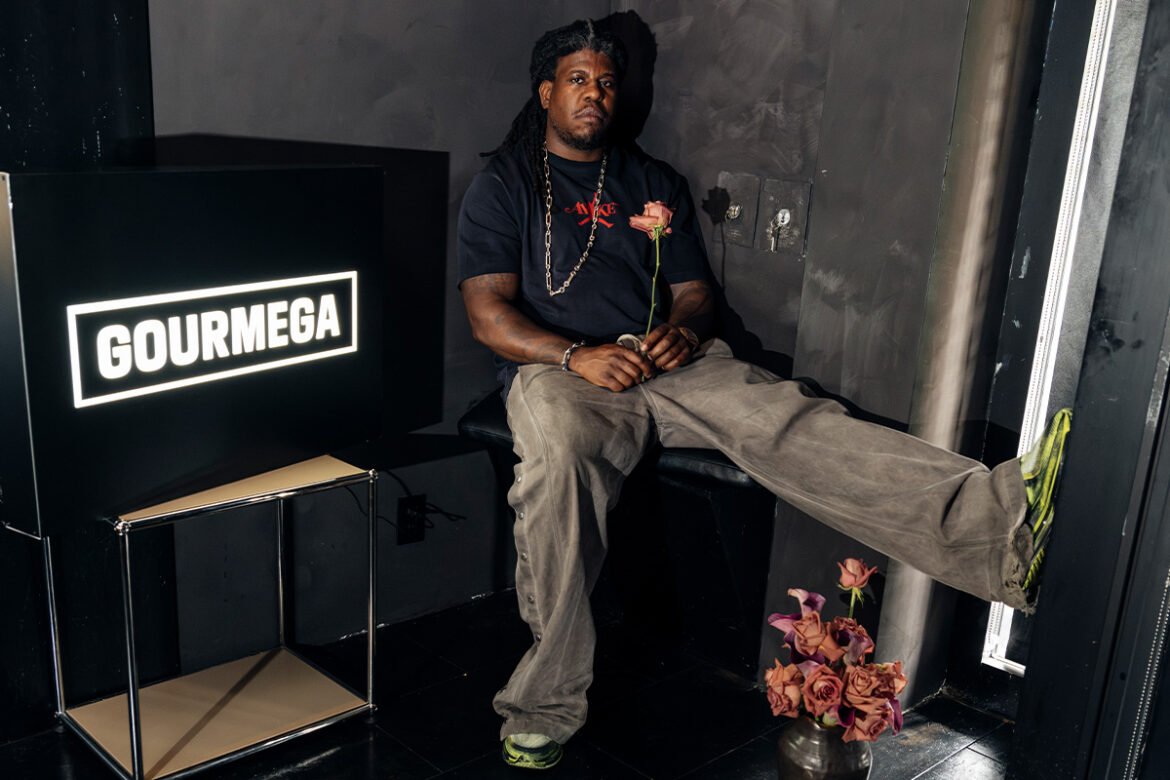
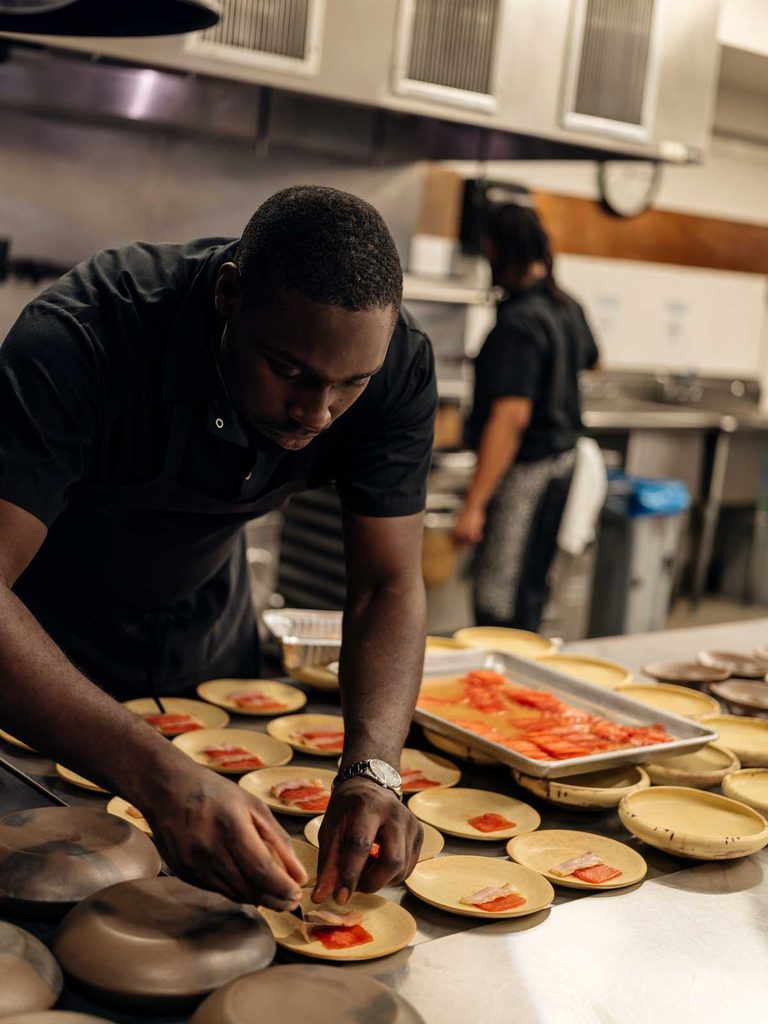
By day, Rethink Food‘s Sustainable Community Kitchen on West Houston Street is a hive of virtuous activity. Chefs for the organization, founded by Matt Jozwiak and Daniel Humm of Eleven Madison Park, produce up to 6,000 restaurant-quality meals per week there to be distributed to food-insecure people across the city.
But by night, when the loading dock goes quiet and the security gate is drawn down tight, the space inside comes alive in a different form: as Gourmega, one of the city’s most exclusive and unusual restaurants.
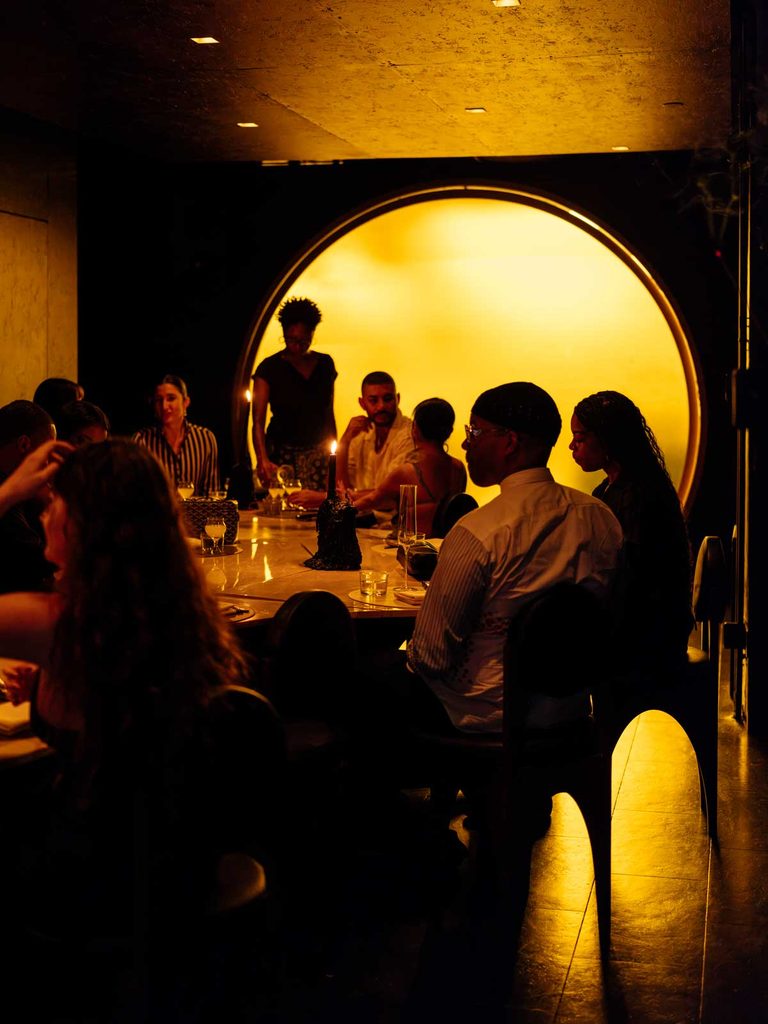
The brainchild of Jon Gray, a founder of the culinary collective Ghetto Gastro, Gourmega is part clandestine supper club, part Afrocentric cultural salon. Reservations are best made by Instagram DM, and once secured, the price tag for the seven- to 10-course dinner is $307 (raising money and awareness for Rethink Food is central to the restaurant’s mission). With communal seating for just 14 people, “Everybody has to bring something to the table besides their wallet. Vibes are important,” says Gray.
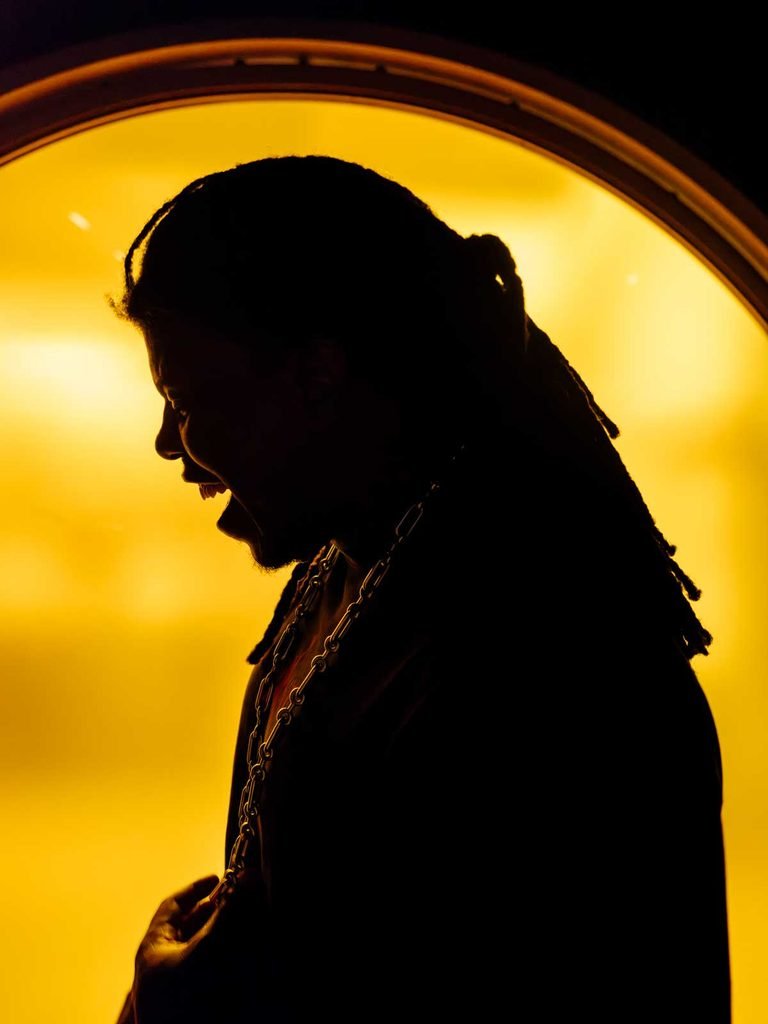
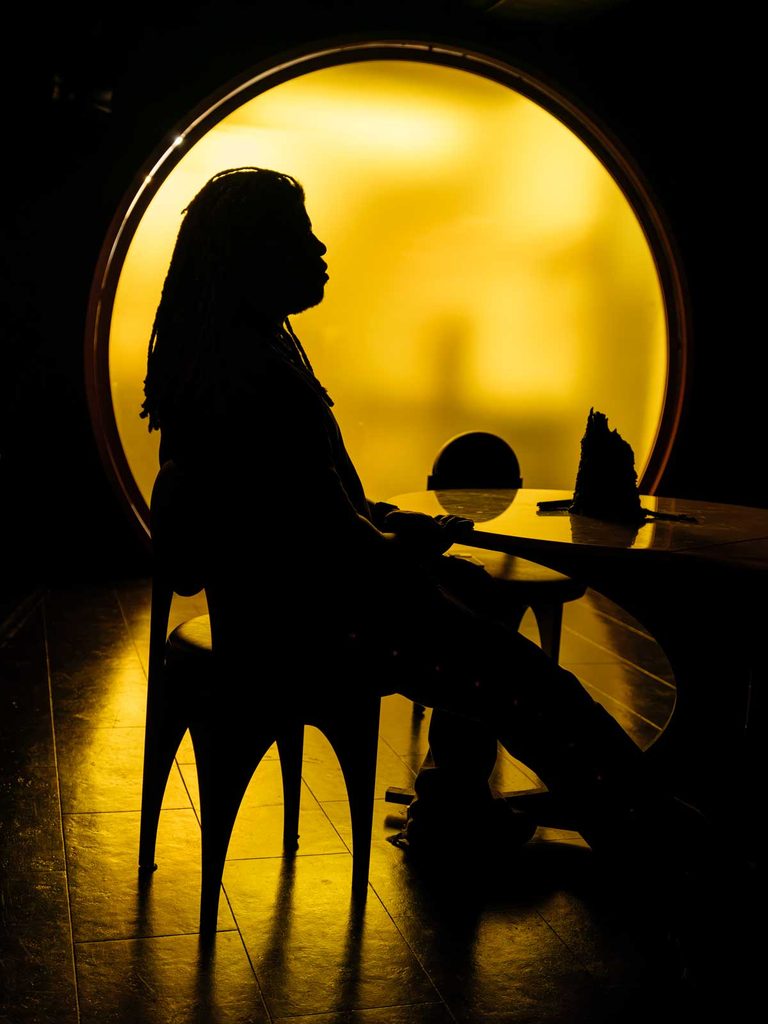
Even the table itself contributes. Made of alabaster and tavertine and designed as a series of interlocking circles to avoid hierarchical seating arrangements, it’s built to facilitate conversation. It, and the rest of the space were designed by Mariam Issoufou Architects, a firm with offices in New York and Niger. The circular motif is echoed in the round, translucent yellow door between the dining room and the kitchen, which casts a solar glow on the black limewashed walls, adorned with works by artists Rashid Johnson and Nifemi Marcus-Bello.
I’m at the age where I can’t complain about what doesn’t exist in my city. I have to do something about it.
Jon Gray, founder of Gourmega
The evening, and the seeds of conversation, don’t start at the table but, rather, in a dim adjacent stockroom, lit by a glassdoored refrigerator. In the center of the room is a shrine with African masks and statuary, fruit, books, and woven palm fronds. Along with a welcome beverage—recently it was the Egyptian hibiscus drink karkade—it is where diners learn about Rethink Food’s mission and the surprising history of the area, which in the Dutch Colonial era was known as the “land of the blacks.”
While neighborhood history and the mission of the space lend the restaurant an air of inevitability, it was anything but, says Gray. “I was so against the idea of a brick-and-mortar early on, because I was just so thirsty to be able to move around and travel and soak everything in and also spread our gospel internationally.” This means blending cross cultural outreach with the charitable, egalitarian refrain of “everybody eats.” Connecting culture in the same way that hip-hop layers samples: “As a way to expand, comment, shake up, share, and revel in our collective memory,” says Gray.
But now, he says, “I’m at the age where I can’t complain about what doesn’t exist in my city. I have to do something about it.”
Before co-founding Ghetto Gastro in 2012 with the mission of bringing “the Bronx to the world, and the world to the Bronx,” Gray had spent time as a “marijuana hustler,” and then running a clothing company, Mottainai. All the while, he was drawing inspiration from restaurants like La Esquina, Beatrice Inn, and later the Cecil, by Alexander Smalls. “Jon was always in the lounge, full of questions,” recalls Smalls. “He would bring his boys, and also his mother.”
As Ghetto Gastro, Gray, along with co-founders Lester Walker and Pierre Serrao (and, for a time, Malcolm Livingston II) quickly went from apartment-hosted dinners and raucous “waffles and models” parties to a globe-spanning showcase of black history, culture, and foodways. They popped up in rarified locations like the Oscar Awards Governors’ Ball (with Wolfgang Puck) and at the Place Vendôme in Paris. Patrons and friends for their events ranged from A$AP Rocky and Cardi B to Martha Stewart and designer Rick Owens, along with corporate supporters like Nike, Cartier, and Audemars Piguet.
It was those connections that helped forge the relationship between Ghetto Gastro and Rethink Food. During the pandemic, Jozwiak reached out to Gray, sharing some of the challenges he was seeing around Mott Haven in the South Bronx. (A big part of Rethink Food’s model is hiring beloved, reliable neighborhood restaurants to produce meals for local distribution.) “Jon said ‘put me in, Coach,’” says Jozwiak. “Jon quickly responded by raising about $400,000, most notably from Audemars, an incredible partner we worked with for years. We were all of the sudden cranking out 5,000 meals a week just in that little area.”
Though Ghetto Gastro is just Gray and Serrao these days, it remains as vital as ever—they’re creating a test kitchen and studio space at WSA near the South Street Seaport—Gourmega is very much Gray’s baby. “I look at Ghetto Gastro as Wu-Tang Clan,” says Gray. “Wu-Tang had Enter the Wu-Tang (36 Chambers), where it was their group effort. Gourmega is more of a solo effort for me. Within groups, and with shared identity, you also have projects that are personal that you want to explore.”
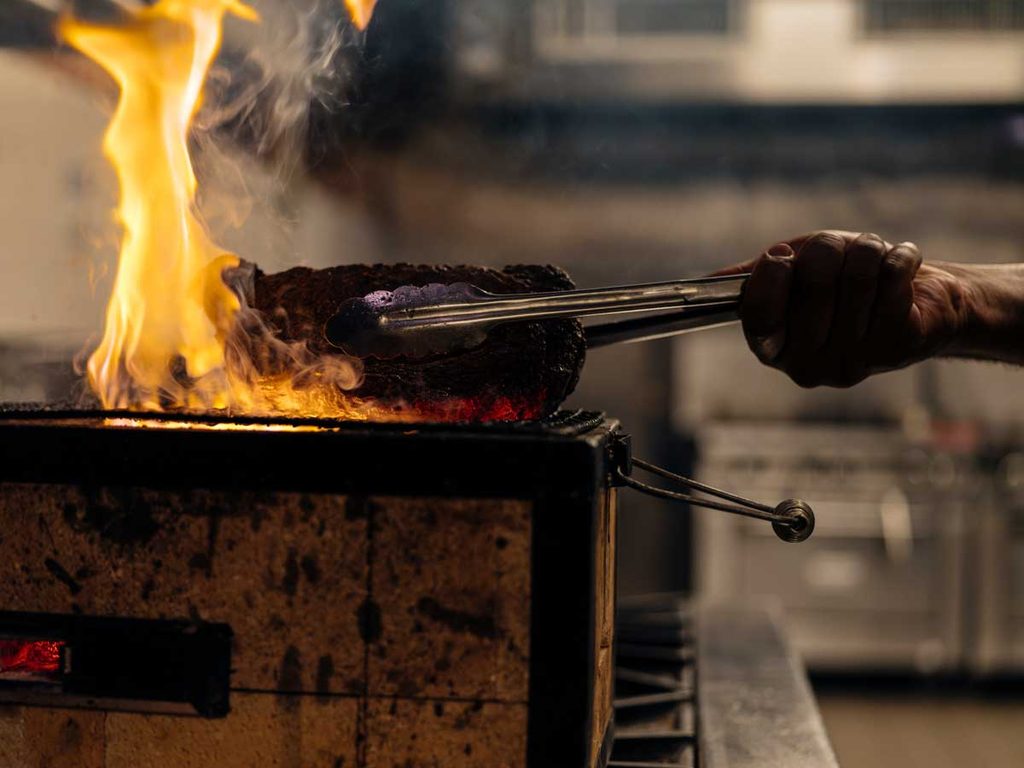
At Gourmega, Gray leans hard into art and design, music and history, while Harold Kenyon and Darnell Charles, who was cooking at the Michelin-starred restaurant Frenchie in Paris when Gray first met him, oversee the “Afro-Asiatic Americana” menu. Think king crab served nigiri-style on crisp red rice, and ribeye steak served with a pavé of Japanese yam. The name of the dish, diners were told, was “the Steaks is High,” a play on the name of a song by De La Soul, which played along with the course.
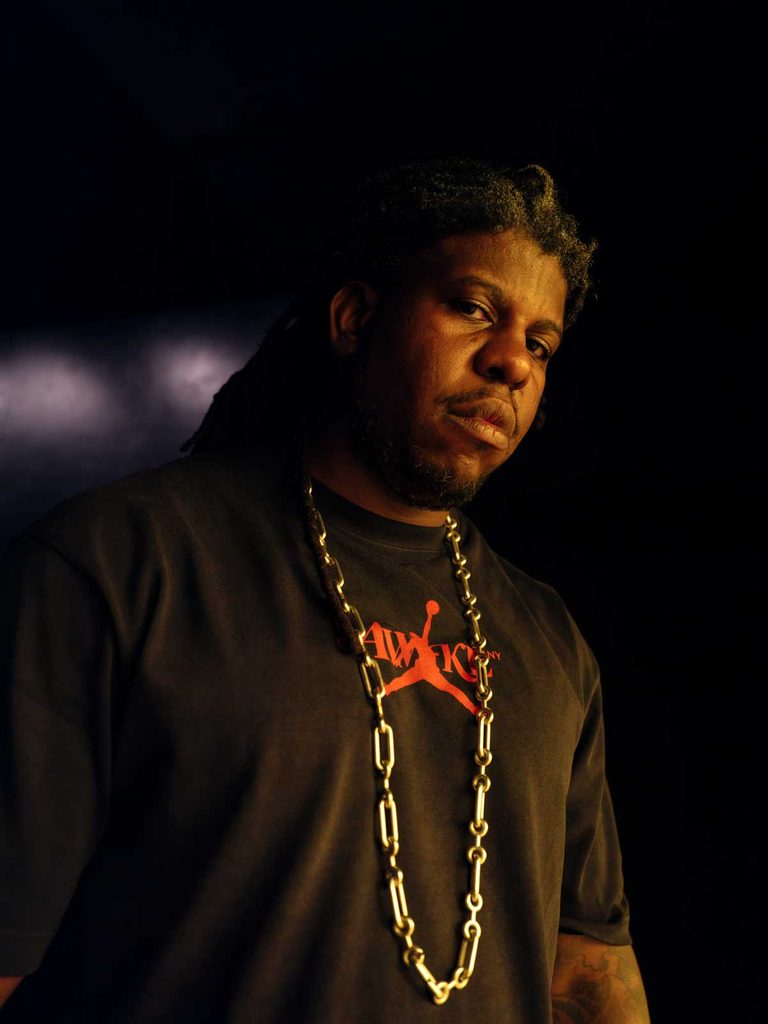
Thinking of the social mission he’s supporting, the historical and cultural legacies he’s highlighting, and the lessons he’s carrying forward from mentors like Alexander Smalls, Gray readily acknowledges the size of his—and Gourmega’s—undertaking, saying, “We’re standing on the shoulders of giants.”
GOURMEGA
Greenwich Village | @gourmega


