

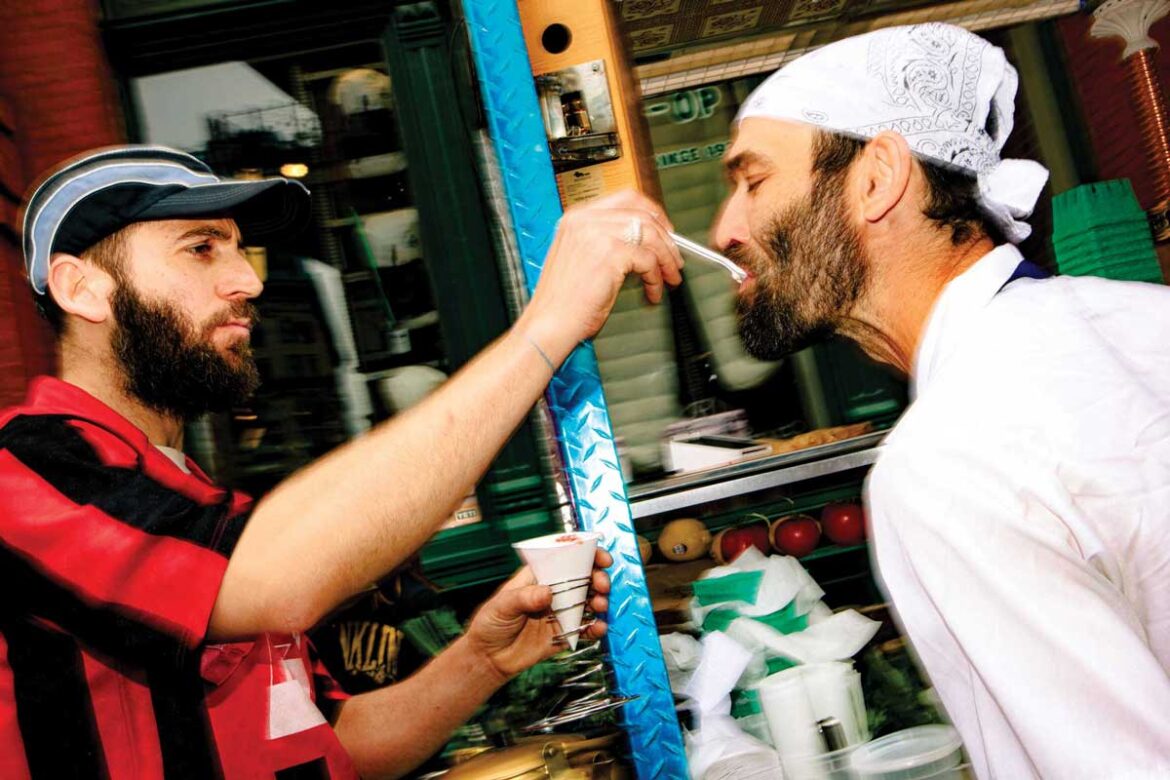
For roving Levantine food pop-up LEV, cooking often takes on the shape of performance: fish hung from a chain-link fence to dry in the wind, a deep-red strawberry “bleeding heart” dripping juice onto an almond-and-mascarpone cream wedding cake, a sculptural tower of ice blocks layered with tuna sashimi. The partners behind these scenes, Loren Abramovitch and Daniel Soskolne, are fully aware of the visual charge their work carries, but artfulness is never the only goal. These moments emerge from the way they solve problems, respond to space, and follow instinct. “We’re very good at figuring out things on the spot,” Soskolne says. Their Bed-Stuy backyard, crowded with ongoing projects—a cold smoker being welded together, a wood-fired oven rising brick by brick—functions as a workshop where craft and curiosity shape every decision.
LEV describes what they do as “site-specific cooking,” a practice rooted in responding directly to the architecture, constraints, and energy of a place. Rather than arriving with a fixed menu or predetermined look, they adapt to whatever the site offers—trees, staircases, fountains, shelving, weather—and build the experience from there.

That approach has made them sought-after for weddings, private dinners, and events for design-driven clients and “cool brands,” as well as their sporadic Oasis gatherings at a famous party house on Hancock Street, announced through Instagram.
Abramovitch and Soskolne met in Israel in 2010, introduced by a mutual friend who insisted they should cook together. “We basically had a blind date,” Soskolne says. They eventually worked under the same chef, an experience that shaped their shared language. “He had a big influence on both of us,” Soskolne explains. “Simple and good quality ingredients but understanding processes, understanding the beauty of how to showcase what you’re doing. And also thinking emotionally about food, not just being very brainy.”
Food Becomes Art: Improvised Installations
That emotional approach shows up everywhere—in how they cook, how they plate, how they build environments around food. Abramovitch describes their visual sensibility as something that grew naturally, not as a conscious pivot toward “presentation.” “Even the word presentation came later,” he says. “For us, it’s just the normal way to put stuff. We never had plastic containers in the restaurant. We never stored things in ugly vessels. You cannot have things that don’t appeal. A lot of what we do is open to the eyes of the guests, so it’s a non-separable part of the cooking.”


Their refusal to open a restaurant is part of the same philosophy. “It’s a boring experience in a way,” Abramovitch says. “Every day, same food, same room.” Soskolne adds that restaurant life can pull cooks away from cooking itself: “You can very easily get lost in that world rather than be in the moment.”
LEV’s work depends on movement, adaptation, and the freedom to build something new each time—conditions a brick-and-mortar space can’t easily offer.
Every event becomes a site-specific project. Sometimes that means adapting to a client’s rigid plan; other times, it’s full creative freedom. “The more clients give us a free hand, the more work we have,” Abramovitch says, meaning the more creative responsibility LEV takes on. “We have to do a site visit, see what’s there, think about how people will eat it, and what the result will be.” When a shoe store asked them to create an installation without even seeing a menu, they built a bagel tree from magnolia branches clipped from their garden that morning. “Everything that is new for the eye, people get attracted to that,” Abramovitch says. “It’s unusual.”

Extemporization is central to LEV’s identity. One of their most striking images on Instagram—a row of carp hanging from a chain-link fence—wasn’t planned as an installation at all. “That picture took a lot of people’s attention,” Abramovitch says, “But it was just there because we had to dry the fish. Why waste tons of paper? Wind is a better way.” Soskolne laughs. “It was very us, improvising and figuring out how to deal with something with what you have.” Their team, small but deeply invested, helps carry that ethos forward. Sous chef Sofie Taddeo has been with LEV for three years, first meeting them during a residency in SoHo. “I couldn’t imagine cooking the same thing every day in a restaurant,” Taddeo says. “Being in this environment is incredible. It’s always changing. You learn a lot, more and faster, because you have to figure something out.”
Cook Anna Dua, who joined last year, agrees. “There’s a freedom here and an openness to experience,” Dua says. “Restaurants have a lot of structure. Here, people who come to LEV events aren’t expecting it to be the same. It’s always dynamic.”
This year, LEV’s backyard gained a new feature: a wood-fired oven built by baker Camille Oldani, who had never poured concrete or laid block before. “I’d had it in my head for a while to build an oven,” Oldani says. “I want to understand bread from different angles.”


Oldani built the oven using plans from The Bread Builders, a book about hearth loaves and masonry ovens published in the late 1990s. “I’d wake up dreading everything I didn’t yet understand about what needed to get done, always doubting myself,” she says. Her father, a fabricator, flew in from California to help cut bricks and brought her grandfather’s masonry tools. “At the end of each work day, materials would come together into something recognizable, and I’d feel this huge rush of relief and accomplishment.” Her philosophy aligns naturally with LEV’s. “Food is tied up with history and tradition, and I think LEV knows how to invite people into the artistry and sociability of cooking,” Oldani says. “Every time I see them cooking, they’re trying something new—but they also use all these cool old tools and old ways of cooking that invite people to ask questions and learn.”
That mix of experimentation and old-world technique runs through LEV’s work. It’s an approach that treats cooking as both discipline and discovery, tradition and innovation. For Abramovitch, the work is never about spectacle alone—it’s about the discipline beneath it. “We’re not artists before we are craft people,” he says. “The craft will always be the first, and then the art is a result.”


