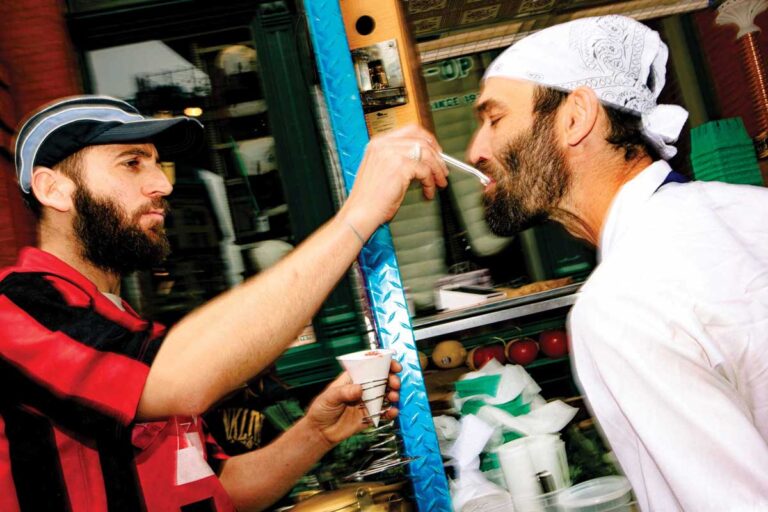


“People arrive here from somewhere else, take what they know, take what they can find and create something new,” says Pervaiz Shallwani, chef, journalist, and founder of Chaat Dog pop-up. “That something new is American food.”
Like so many immigrant foods before and after it, the hot dog arrived to the US from Germany in the 19th century as an outsider before earning its place as a national street food icon. It was considered strange, even controversial, but that history—and ultimate assimilation—is exactly why Shallwani chose it for Chaat Dog.
With his Desi-American street food mashup, Shallwani brings together two disparate culinary worlds that encompass his upbringing: the American hot dog, which reigned in his hometown of Chicago; and the bold flavors of South Asian chaat his Pakistani relatives served. Chaat is an umbrella term for South Asian snacks that combine textures and flavors–like crunchy, creamy, spicy, sweet, and tangy–all in one bite. But the philosophy behind Chaat Dog isn’t simply about serving creative, tasty bites. It’s about asking a larger question: Who gets to define American food?


“I took this total risk and started this thing,” Shallwani says of launching Chaat Dog while still balancing his career in journalism. “I didn’t know how people were going to react.” But the brilliance of the concept is precisely how it bridges cultures and cuisines starting with a known departure point. “For people who don’t know what chaat is, they know what a hot dog is,” he explains. “I’m already halfway there.”
Chaat Dog has come a long way since starting as pop-ups in 2022. With a successful launch at Brooklyn’s Time Out Market Hall in June, Shallwani has his sights on opening a dedicated brick-and-mortar location one day.
He says other South Asians often tell him they feel “seen” after they experience Chaat Dog for the first time and learn about its mission. For many Americans, the concept reflects a familiar journey: growing up trying to assimilate while eventually realizing that becoming American does not mean leaving your culture behind.
Shallwani explains immigrants often find themselves amidst a dichotomous identity. “They think, ‘That’s who I am. I’m not fully South Asian, and I’m not fully what people think of as American,’—but that’s exactly what being American is.”
Not Fusion, American
That evolution is at the heart of Shallwani’s business and broader storytelling project, Stinky Lunch Kids Strike Back, a multi-faceted platform and conversation starter exploring identity, community, and the role food plays in helping people understand one another through Instagram and soon, a Substack and in-person events.
For many first-generation Americans, the name immediately resonates. It recalls the lunches lovingly packed at home that became sources of embarrassment once opened in a school cafeteria. Foods rich with unfamiliar aromas often became the dividing line between fitting in and standing apart.


Today, Shallwani sees that story beginning to change. Foods once dismissed as “too different” are now the flavors people seek out. The lunches that once invited teasing are becoming celebrated expressions of culture.
For him, Chaat Dog isn’t fusion. It’s American. “If you are here long enough, your flavors become part of what is ‘American’ food. It’s inevitable,” he says, pointing to a tradition of assimilation that reaches back to Colonial times.
Taking a Stand
Shallwani was born in Toronto to Pakistani immigrants who eventually settled in Chicago, where the hot dog is practically a civic language. Surrounded by a family of entrepreneurs, including his father, who started a successful driving school, creating a business of his own felt like a likely path for Shallwani, even if the right idea took time to emerge.
After culinary school, Shallwani built a career in journalism, bouncing between jobs in food writing and law enforcement reporting at the Wall Street Journal & CNN, Newsday, and Bon Appétit. The idea for Chaat Dog began in 2017, when Shallwani and his wife created a version of the chaat-style hot dog for a friend’s birthday party. Using tamarind and plum, they made a chutney to go on top. It was a hit. Encouraged by the response, Shallwani continued developing the concept, however the name Chaat Dog didn’t come to him for five years. Hot? Chaat? It finally hit him one day while still at CNN, no longer happy with what he was doing professionally.

The Devil in the Details
The details matter. For Chaat Dog, Shallwani uses Chicago-style Vienna Beef hot dogs, which are quickly dunked in water, then griddled to gain a little char, before being placed in toasted buns that are brushed generously with ghee; every element of the final bite is carefully considered. “How you treat the dog matters,” he says. (There are also chicken and veggie options available.)
The classic Chaat Dog menu includes The OG Chaat Dog, which has potato chaat masala, green and red chutneys, fried onions, and spiced chickpea crunchies; The Achaar Smashburger: Two all-beef achaar-laced patties with lettuce, cheese, pickled onions, and secret achaar sauce on a ghee-toasted bun. Achaar is like an intensely concentrated relish. Also popular is the Walking Chaat: A Desi play on Frito pie using a bag of Fritos or Doritos topped with corn and poblano chaat, green and red chutneys, fried onions, and boondi and sev, which are variations of fried chick pea flour. There’s also the Chopped Cheese, a South Asian nod to New York: An achaar smash burger chopped with cheese, special sauce, lettuce, pickled onions, and Fresno peppers on a ghee-toasted bun. Or, you can get adventurous and order a Chaat Dog flight, which includes the OG potato; corn and poblano; and a seasonal fruit chaat (currently mango).
Hot Dogs with Friends Collab Series
The spirit of exploring American Food and all its layers extends beyond his own menu. Over Memorial Day weekend, Chaat Dog launched Hot Dogs with Friends, a summer-long weekly collaboration series inviting chefs to create their own signature hot dogs. Many of the participating chefs, Shallwani notes, were “stinky lunch kids” themselves.
The series kicked off on Memorial Day Weekend with Puerto Rican author, chef, and TV host Monti Carlo, who piled her signature morcilla sloppy joe onto a hot dog with raw onions, cilantro, and pique. Other guests since have included Mexican chef and author Fany Gerson, who teamed up with Danny Ortiz on the Mexican Street Dog, a bacon-wrapped hot dog topped with pico de gallo, ketchup, mustard, and pickled jalapeños; as well as Brazilian-American chef and writer Carolina Santos-Neves, whose Crunchy Carioca dog was topped with a refreshing Molho Campanha, creamy requeijão, and batata palha. Egyptian-Bolivian chef and author Ham El-Waylly brought his mom Pimpi’s famous chili con carne, layered with Tillamook cheddar, minced onions, Brazilian potato sticks, and fresh chives; while Korean chef Jae Jung‘s KJUN Dog was a Korean-Cajun mashup of gochujang sausage, gochujang honey, Tabasco mayo, and chives.
Last week, the “Mr. Miyagi” special, by chef Erik Ramirez of Peruvian restaurant Papa San, was the guest star, featuring a combination of wasabi mayo, nori, and crispy onions that delivered one of those rare “where has this been all my life?” moments.


Between July 21-26, Chaat Dog and Hot Dogs with Friends continues with “The Bandari Dog” by American Persian chef Sohail Zandi of Brushland Eating House in Bovina, NY. It includes Sosi Bandari onion relish, hard-boiled egg, tomatoes, Persian cukes, and dijon mustard.
After that, Russ & Daughters (July 28-August 2) and Top Chef finalist Lana Lagomarsini (August 4-9) take the reins this summer and create a signature for the Hot Dog & Friends series, which Shallwani says is doing so well, it will likely continue beyond Labor Day.
For Ramirez, the collaborations represent something larger than a special menu item. His own restaurant explores Japanese influences on Peruvian cuisine, another example of how cultures combine, adapt, and create something new.
“There’s something powerful about taking a food that feels so familiar, so approachable, and so distinctly American and using it as a canvas for different interpretations that reflect both the chefs’ cultural backgrounds,” he says.
This summer, Chaat Dog’s conversation continues beyond Time Out Market, including a weekly residency on Friday and Saturdays at Brooklyn venue House of Yes. Each event reinforces Shallwani’s belief that American food has never been fixed. It has always evolved with the people who arrived here.
At the end of the day, Shallwani is a storyteller first and foremost. Chaat Dog is simply his latest medium. One hot dog at a time, he is inviting people to rethink one of America’s most familiar foods—and expand their understanding of who gets to shape the country’s culinary identity.