


Who is Kali Prasad, AKA Eight? A Taste of Vengeance
Kali stranger things is a search that brings you to one of the most controversial yet pivotal characters in the Netflix series. But for food lovers, her name holds a special significance. Kali Prasad, also known as Eight or subject 008, is Eleven’s “sister” from Hawkins Lab, and her last name, Prasad, refers to a food offering in Hindu traditions—a fascinating detail for a character who offers Eleven a very different path.
Quick Facts about Kali:
- Real Name: Kali Prasad (a name with a delicious double meaning for foodies!)
- Lab Number: 008 (Eight)
- Powers: Creates realistic illusions, can make herself and others invisible, manipulates perception
- Actress: Linnea Berthelsen (Danish actress)
- First Appearance: Season 2, Episode 7 (“The Lost Sister”)
- Connection to Eleven: Both were test subjects at Hawkins Lab under Dr. Martin Brenner
- Season 5 Role: Returns in a shocking reveal that sets up Eleven’s final sacrifice
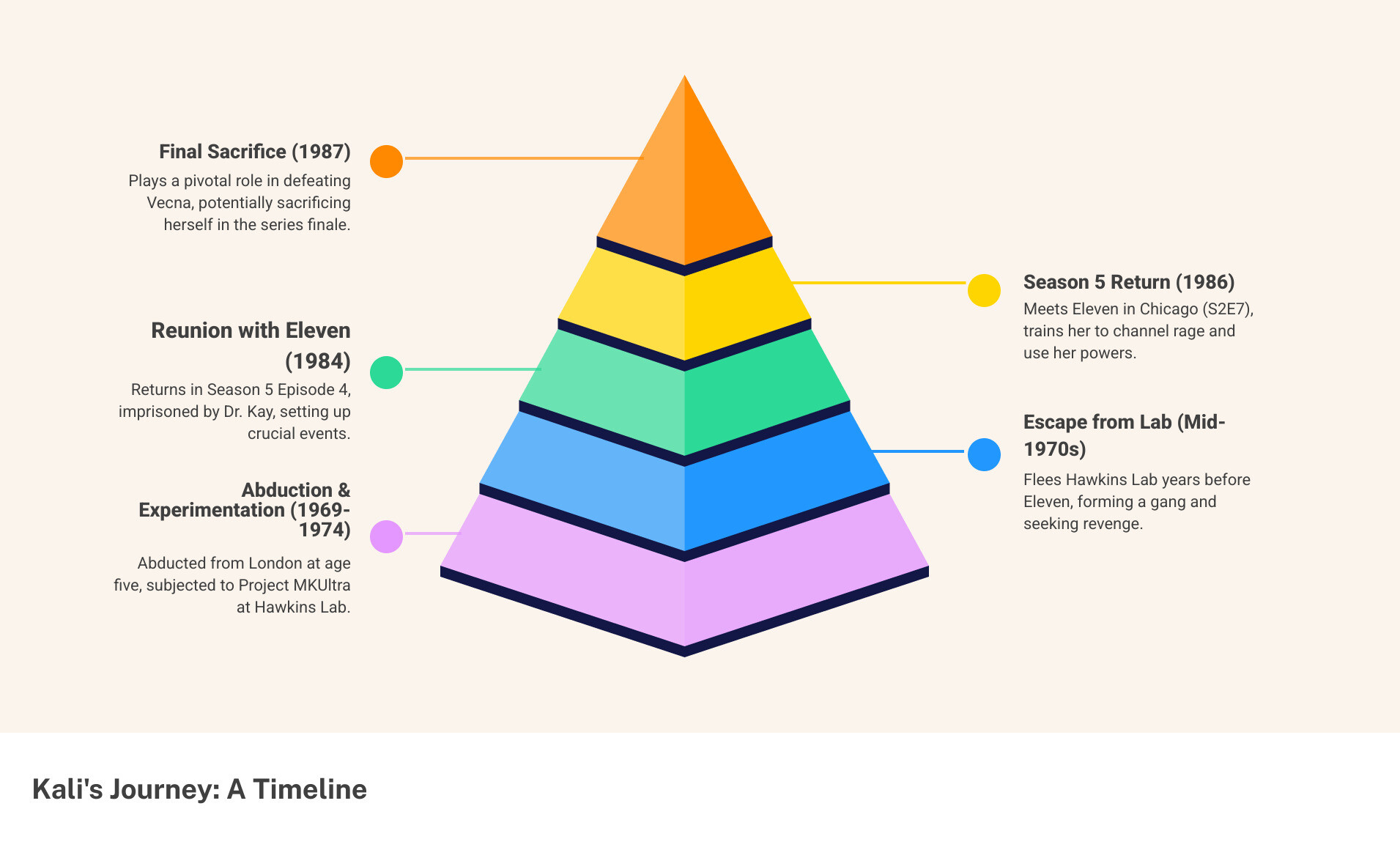
Kali was abducted from London in 1969 at age five and experimented on at Hawkins Lab. Unlike Eleven’s telekinetic powers, Kali developed the ability to warp other people’s perceptions—making them see, hear, and feel things that aren’t real. She escaped the lab in the mid-1970s, years before Eleven, and spent her life seeking revenge against those who hurt her.
Her appearance in Season 2 sparked massive debate among fans. The episode introducing her holds the lowest IMDb rating of any Stranger Things episode (6.1 out of 10), yet the Duffer Brothers brought her back for Season 5 because, as they stated, her involvement was essential to telling the story completely.
Kali taught Eleven crucial lessons about channeling rage and emotion to strengthen her powers—and about the dangerous path of revenge. Though Eleven ultimately chose to leave Kali behind to save her friends in Hawkins, their bond shaped Eleven’s journey in ways that became critical to the series finale.
Kali stranger things glossary:
- jamie campbell bower
- joe keery
Origins and Powers: A Recipe for Revenge
Our journey into Kali stranger things begins with her mysterious origins, deeply entwined with the nefarious experiments conducted at Hawkins Lab. Kali Prasad, known by her designation Eight, is one of the many child test subjects who endured horrific procedures under Dr. Martin Brenner’s Project MKUltra. Her backstory paints a vivid picture of a childhood stolen—a life devoid of flavor and choice, likely sustained by the bland, institutional food of the lab.
Kali’s story starts years before Eleven’s, with her abduction from London in 1969 at the tender age of five. She was brought to Hawkins Lab, where she was subjected to the same cruel experiments that would later shape Eleven. The “Rainbow Room,” a seemingly innocuous play area, was where she and Eleven briefly played together, forming an early, unspoken bond amidst their shared trauma. It’s a poignant image, two powerful children unknowingly connected by their suffering.
Kali managed to escape Hawkins Lab in the mid-1970s, long before the events that led to Eleven’s own escape and the subsequent chaos in Hawkins. This early escape meant she had years to hone her unique abilities and develop a fierce desire for revenge against those who wronged her. Her quest for retribution led her to form a gang of outcasts in Chicago, individuals who also felt marginalized by society. This group became her surrogate family, and one can imagine them sharing meals—perhaps deep-dish pizzas, a stark contrast to the culinary wasteland of the lab—as they plotted their form of vigilante justice.

Dr. Martin Brenner, often referred to as “Papa,” was the orchestrator of these experiments. His goal was to open up and control psychic abilities, believing these children were the key to national security. Kali’s existence, along with other numbered children, underscores the vast and disturbing scale of Brenner’s unethical research, which extended far beyond the confines of Hawkins, Indiana.
Kali’s Unique Abilities
What sets Kali apart from Eleven, and indeed from other known psychics in the Stranger Things universe, are her distinct powers. While Eleven possesses powerful telekinesis, Kali’s abilities are rooted in psycho-hallucikinesis, a form of perception manipulation that allows her to create incredibly realistic illusions.
Her powers manifest in several ways:
- Illusion Creation: Kali can conjure vivid and tangible illusions, making people see, hear, and even feel things that aren’t actually there. We witnessed this when she made a police officer believe a bridge was collapsing, or when she tormented one of her gang members by making him see spiders. These illusions are so convincing they can disorient, terrify, or even paralyze her targets.
- Invisibility: A direct application of her illusion powers, Kali can make herself and others appear invisible to the naked eye. This isn’t true invisibility but rather a powerful illusion that fools onlookers into believing they aren’t there. This ability proved incredibly useful for her and her gang to evade authorities or infiltrate locations.
- Phantasmagoria: This term describes the rapid succession of illusions she can create, overwhelming her targets’ senses. It’s a terrifying display of her control over perception, capable of driving her victims to madness or submission.
- Perception Manipulation: Beyond creating specific illusions, Kali can subtly alter how others perceive reality, making them miss details or focus on fabricated elements. This separate aspect of Henry Creel’s powers, distinct from his telekinesis, makes her a formidable and psychologically impactful force.
However, even formidable powers have their weaknesses. Kali’s illusions are hindered by sonic weapons. High-frequency sounds can disrupt her concentration and break her control over perceptions, making her vulnerable. This detail becomes particularly important in Season 5, as we dig deeper into the military’s understanding and counter-measures against individuals with psychic abilities.
The Actress Behind the Character
The compelling character of Kali Prasad, or Eight, is brought to life by the talented Danish actress Linnea Berthelsen. Her portrayal adds a layer of depth and intensity to a character who, despite limited screen time, leaves a lasting impression.
Born in India and adopted, Linnea Berthelsen studied at the prestigious East 15 Acting School in Essex, England. Her acting career began in her early teens, with her debut in the short film ‘Mirrors’ in 2016. However, it was her role in Stranger Things that propelled her into the international spotlight.
Berthelsen’s casting as Kali was a significant moment for the series. Originally, the character of “Roman” was conceived as male, but the Duffer Brothers ultimately decided to change it to Kali, creating a powerful female counterpart to Eleven. This decision led to a rich character development, exploring themes of sisterhood, trauma, and revenge from a unique perspective.
In interviews, Berthelsen has shared insights into her experience playing Kali. She explained how Kali’s controversial episode in Season 2 was challenging, especially in portraying the character’s emotional state. Linnea Berthelsen discussed her character’s controversial episode 7, noting that Kali was experiencing emotions she hadn’t before, leading to a sense of being lost and confused. She believes it’s often best not to over-explain such emotional states, allowing viewers their own interpretations. Her dedication to the role, including shaving her head and adopting purple hair, further cemented her commitment to Kali’s distinctive look and persona.
Beyond Stranger Things, Berthelsen has also appeared in the miniseries ‘Devs’, showcasing her versatility as an actress. Her return as Kali in the fifth season of Stranger Things in 2025 further solidified her place in the show’s legacy, proving the character’s enduring importance to the narrative.
A Controversial Connection: A Different Kind of Nourishment
The relationship between Kali and Eleven is one of the most complex and, at times, contentious elements of the Stranger Things narrative. Their reunion in Season 2, specifically in Episode 7, titled “The Lost Sister,” was a pivotal moment for Eleven’s journey, though it proved divisive among audiences.
The Impact of the “kali stranger things” Storyline
Season 2, Episode 7, “The Lost Sister,” took Eleven on a solo journey to Chicago, where she sought out Kali and her gang. This episode marked a significant departure from the main Hawkins storyline, both geographically and tonally. It introduced a punk-rock aesthetic and a gritty, revenge-driven plot that stood in stark contrast to the supernatural horror unfolding back home.
Fan reception to this episode was notoriously mixed, with many viewers finding it to be an unwelcome interruption to the main plot’s momentum. It holds the lowest IMDb rating of any Stranger Things episode, with a 6.1 out of 10 from 35,000 reviews, compared to the second-lowest rated episode’s 7.8. This widespread sentiment highlights the challenges the Duffer Brothers faced in integrating Kali’s storyline.
However, the Duffer Brothers’ creative risk in dedicating an entire episode to Kali was intentional. Ross Duffer later stated that when viewers watch all five seasons straight through, “It doesn’t feel like we dropped a storyline — it all connects.” They viewed Eleven’s storyline with Kali as a significant risk, but one necessary to keep the show dynamic and to further Eleven’s character development.
The narrative purpose of Kali’s storyline was profound. Kali, with her street-smart demeanor and raw anger, offered Eleven an alternative path—a different kind of nourishment for her growing powers. While Hopper and her Hawkins friends provided a diet of love and protection, Kali served up a menu of vengeance and self-reliance. She taught Eleven to channel her rage and memories, turning the bitter taste of her trauma into a source of power. This was a crucial lesson for Eleven, who often struggled to control her emotions and powers.
Here is a list of key lessons Eleven learned from Kali:
- Channeling Rage: Kali showed Eleven how to tap into her anger and past trauma to strengthen her abilities, teaching her that emotions, even dark ones, could be a source of power.
- Self-Acceptance: By finding another “sister” with powers, Eleven began to understand that she was not alone and that her abilities were a part of her identity, not just a curse.
- Defining Her Own Justice: Kali’s vengeful methods forced Eleven to confront her own moral compass and decide what kind of hero she wanted to be.
- The Power of Sisterhood: Despite their differences, the bond with Kali underscored the importance of family and connection beyond blood.
- “Bitchin'”: Perhaps less profound but certainly memorable, Kali taught Eleven this iconic slang term, which Eleven adopted with enthusiasm. Hopper even brings this up in Season 5, in case we forgot!
Why Eleven Left Kali Behind
The climax of “The Lost Sister” came when Kali and her gang tracked down Ray Carroll, a former Hawkins Lab technician responsible for some of the cruel experiments. Kali wanted to kill him, but Eleven, seeing a photograph of Ray’s family, hesitated. This moment was the ultimate test of Eleven’s moral choice.
Eleven ultimately rejected the path of vengeance. She chose to protect an innocent family, even if it meant letting one of their tormentors live. This decision highlighted her inherent compassion and her growing understanding that true strength lies not in revenge, but in love and protecting those she cares about.
Her choice to return to Hawkins was driven by her newfound conviction to protect her friends and Hopper, who were in grave danger from the Mind Flayer. Leaving Kali behind was a painful but necessary step in her journey. It marked a crucial point in Eleven’s development, solidifying her commitment to her chosen family and defining her as a hero who fights for life, not death. Despite the unresolved sisterhood, this divergence shaped Eleven into the character we know and love, ready to face the ultimate threats in Hawkins.
The Shocking Return: A Dish Best Served Cold?
The return of Kali Prasad in Stranger Things Season 5 was one of the most unexpected and impactful reveals of the final season, proving that her story was far from over. After years of speculation and fan debate, our “lost sister” reappeared, serving up a cold dish of reality for both the characters and the audience.
What is the significance of the “kali stranger things” return?
Kali’s return in Season 5, Volume 1, was unveiled in a chilling moment: she was finded in Dr. Kay’s mysterious vault, held prisoner and subjected to further experimentation by the military. This setup immediately amplified the stakes and provided a crucial link to the overarching plot.
The significance of her return can be understood on several levels:
- Narrative Redemption: For many, Kali’s initial appearance felt like a detour. Her return in Season 5 offers a chance to retroactively validate her storyline from Season 2 and integrate it more fully into the series’ conclusion. It suggests that the Duffer Brothers had a long-term plan for her character, aiming to prove that Eleven’s meeting with her was far from pointless. This integration aims to redeem the “most-hated episode” by giving it a crucial narrative payoff.
- Tying Up Loose Ends: The show had left Kali’s fate ambiguous after Season 2, like a meal left half-eaten. Her reappearance provides closure to her character arc and addresses the question of what happened to the other numbered children from Hawkins Lab. It shows that even those who escaped were still vulnerable to the forces seeking to exploit their powers.
- Exploring New Antagonists: Dr. Kay, played by Linda Hamilton, represents a new faction of antagonists: the military, now actively seeking to harness or neutralize psychic abilities. Kay’s plan was to use Kali’s blood to recreate psychic children, a grim echo of Brenner’s experiments. This introduces a new layer of threat, as the military has developed “sonic weapons” – Kali’s kryptonite – to counter powers like hers.
- Eleven’s Vulnerability and Final Choice: Kali’s capture and the military’s development of counter-measures highlight Eleven’s own vulnerability. Dr. Kay’s ultimate goal was to use Kali’s powers, and eventually Eleven’s, to create a new generation of psychics, or to weaponize their abilities. This directly sets up Eleven’s final, monumental choice: to make a sacrifice to ensure no more children suffer the same fate, and to prevent her blood from being used to create new monsters. The Duffer Brothers emphasized that Kali’s involvement was essential to compelling Eleven to confront this ultimate decision.
Her presence in the Gable Ridge Road Base, a military installation, confirms that the threat to psychics extends beyond the Upside Down. It reinforces the idea that human institutions can be as dangerous as supernatural entities. Her return, therefore, is not merely a cameo but a pivotal plot device that influences Eleven’s ultimate sacrifice and the series’ conclusion.
Kali’s Ultimate Sacrifice in the Series Finale
The conclusion of Kali stranger things story in the series finale is both tragic and heroically significant, a final, bittersweet course. As the battle against Vecna and the Upside Down reaches its climax, Kali plays a crucial role, ultimately making the supreme sacrifice.
In a desperate turn of events, Kali’s unique illusion powers become instrumental in the fight against Vecna. While Eleven’s telekinetic strength is vital, Kali’s ability to manipulate perception offers a strategic advantage, potentially allowing her to trap Vecna in his worst nightmares or create diversions that aid Eleven.
The prevailing narrative, according to leaked plot details and fan theories, suggests that Kali sacrifices herself to save Eleven. This act would cement their sisterly bond and provide a poignant end to her quest for justice, changing it into an act of love and protection. Kali, understanding the immense burden on Eleven and the danger of her powers being exploited, chooses to ensure Eleven’s survival and prevent the cycle of abuse from continuing.
A compelling theory of faked death has also emerged among fans. This theory suggests that Kali, with her mastery of illusions, might have used her powers to fake her own death in the series finale. By creating a convincing illusion of her demise, she could have allowed Eleven to escape, believing her sister was gone, while Kali herself disappeared into obscurity to live a free life, finally free from the pursuit of labs and military forces. This alternative ending, while offering a less tragic fate for Kali, would still serve the narrative purpose of compelling Eleven to make her final choice and ensuring her escape.
Regardless of whether her death was real or an illusion, Kali’s sacrifice (or perceived sacrifice) directly impacts Eleven’s final choice. It pushes Eleven towards her ultimate act of selflessness, demonstrating the profound influence Kali had on her “sister’s” development. Her legacy is not just one of revenge, but ultimately of protection and love for the only family she truly knew.
Fan discussions on Kali’s fate highlight the emotional impact of her potential demise. While some fans were critical of her character initially, her return and ultimate role have sparked renewed appreciation for her contribution to the overarching narrative and Eleven’s journey.
Frequently Asked Questions about Kali
Here we answer some of the most burning questions about Kali, adding a little extra flavor to what you already know.
Are Kali and Eleven biological sisters?
No, Kali and Eleven are not biological sisters in the traditional sense. They are “sisters” through shared trauma and experience. Both were child test subjects at Hawkins Lab, subjected to the same horrific experiments under Dr. Martin Brenner. They shared a brief, formative period in the “Rainbow Room,” a playroom within the lab, where they likely formed an early, unspoken bond. Their connection is one of shared origin and psychic abilities, rather than familial lineage. They represent two different paths stemming from the same tragic past, making their sisterhood a powerful thematic element in the series.
Why was Kali’s episode in Season 2 so divisive?
Kali’s introductory episode in Season 2, “The Lost Sister” (Episode 7), was notoriously divisive for several reasons:
- Pacing Interruption: The episode abruptly shifted away from the main storyline in Hawkins. For many viewers, it felt like a jarring palate cleanser at a moment of high tension, interrupting the narrative flow of the season.
- Tonal Shift: The episode adopted a distinctly different tone, leaning into a gritty, punk-rock aesthetic and a revenge-driven plot in Chicago. This contrasted sharply with the nostalgic, sci-fi horror flavor that fans had come to expect from Stranger Things.
- Introduction of New Characters: The episode introduced an entirely new ensemble of characters – Kali’s gang – who had no prior connection to the main cast. This made it difficult for some viewers to invest in their stories, especially when the core group was in peril.
- Standalone Nature: “The Lost Sister” felt very much like a standalone episode, almost a backdoor pilot for a spin-off, rather than an integral part of the ongoing season. While it was later revealed to be crucial for Eleven’s character development, its immediate placement left many feeling disconnected.
Despite the initial backlash, the Duffer Brothers maintained that the episode was a necessary part of Eleven’s journey, providing her with crucial lessons and a moral dilemma that shaped her future choices.
What is the origin of Kali’s name?
The name “Kali” carries significant cultural and mythological weight, but for food enthusiasts, her full name—Kali Prasad—is what truly tantalizes. In Hindu traditions, prasad is a food offering made to a deity, which is then shared among the devotees. It’s a sacred, blessed food that symbolizes a divine connection. This adds a fascinating layer to her character: is she an offering? Or is she the one making an offering of vengeance?
Her first name, Kali, is that of a powerful Hindu goddess, often associated with destruction and rebirth, and particularly revered in Bengal. This connection opens up a world of culinary exploration. To truly appreciate the cultural context of her name, one might explore the vibrant flavors of Bengali cuisine, which can be found in pockets of New York. Think savory fish curries, delicate sweets like rasgulla, and the complex spice blend of panch phoron.
Furthermore, the Duffer Brothers have cited Indiana Jones and the Temple of Doom as an influence on Stranger Things 2. This film famously features a Kali-worshipping cult and a potion called the “Blood of Kali.” While the movie’s depiction is pure fantasy, it further cements the character’s name in a world of mystique and ritual—themes that often surround the most memorable meals. The first name Kali is a culturally significant South Asian name, and her last name Prasad is also a common last name in South Asia, possibly indicating her Bengali heritage.
Conclusion: The Aftertaste of Kali’s Legacy
As we reflect on the journey of Kali stranger things, it’s clear that her character arc is far more intricate and impactful than a single, controversial episode might suggest. From a lost sister with a name steeped in culinary tradition to a pivotal player in the series’ grand finale, Kali’s story is a testament to the Duffer Brothers’ complex recipe for Stranger Things.
Her unique illusionary powers and her unwavering quest for justice provided Eleven with a starkly different menu of choices, forcing our young hero to decide what truly nourishes her spirit: vengeance or love. Kali’s influence on Eleven’s growth was undeniable, pushing her to channel her rage, understand her past, and ultimately define her own moral compass. The thematic importance of choice and family—both biological and found, often forged over shared meals and experiences—resonates deeply through their intertwined narratives.
In the end, whether through a real sacrifice or a brilliant illusion, Kali’s final act solidifies her legacy. Her story, though at times a bitter pill for some viewers, became an essential ingredient in the rich, complex flavor of Stranger Things, proving that every character can contribute profoundly to the saga’s conclusion.
As the epic saga concludes, the conversation is just getting started. Why not dissect every theory over a great meal? Explore Brooklyn’s vibrant restaurant scene to find your next favorite spot to discuss all things Stranger Things!
