

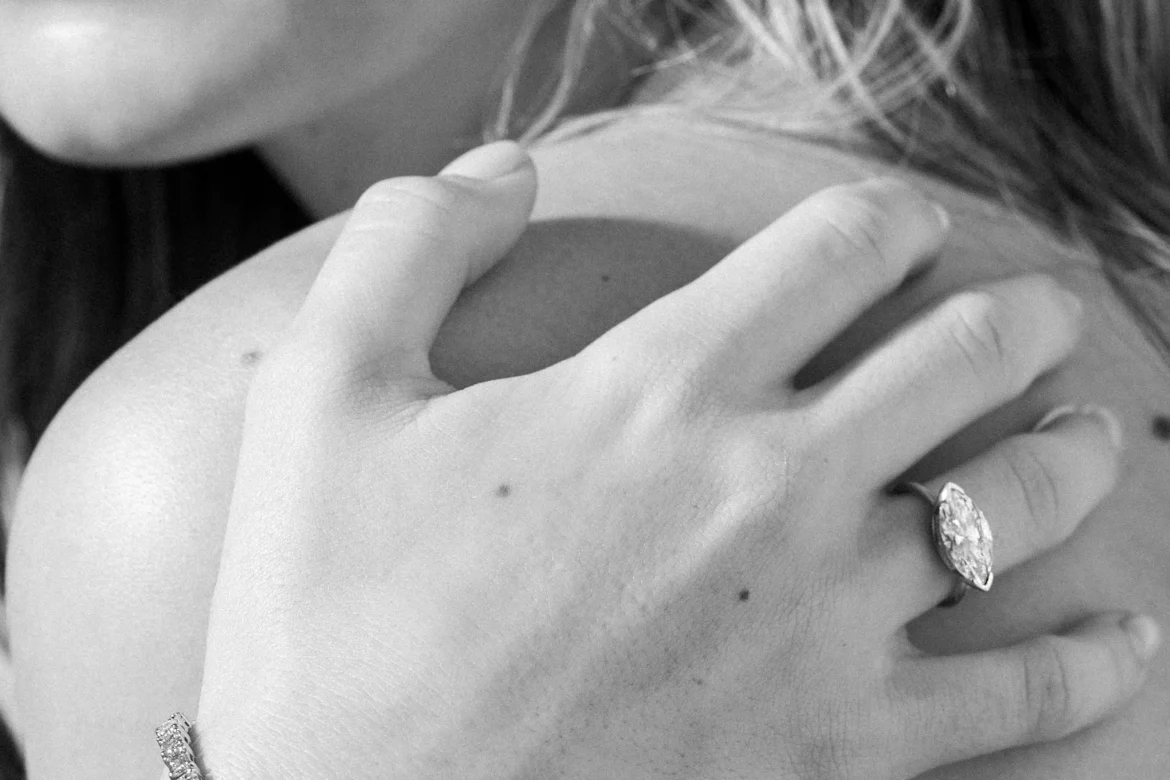
Most people spend weeks or months picking an engagement ring. The wedding band gets maybe an afternoon. Then both go on the same finger, and something looks off. One ring crowds the other, or there’s a visible gap between them, or the metals clash in a way that draws attention for the wrong reasons. The two rings are supposed to work as a pair, but they were chosen at different times, under different circumstances, and often with different priorities in mind.
Getting them to sit well together requires paying attention to a few specific things: the stone’s silhouette, the width of each band, the metal, and how the profiles of both rings interact physically on your hand. None of this is complicated, but skipping over any of it tends to produce results that feel slightly wrong without you being able to say exactly why.
Stone Silhouette Dictates Band Style
The shape of your center stone determines which band profiles will sit flush against it. Round diamonds are the most forgiving here because they pair well with both straight and curved bands. You have options in every direction.
Elongated stones are pickier. Oval, marquise, and pear shapes often look best with curved or contoured bands that follow the stone’s outline. A marquise, with points on both ends, pairs well with V-shaped bands that tuck into its contours rather than bumping against them. Princess and emerald cuts, with their straight edges and geometric lines, tend to work better alongside straight bands that echo their angles. Cushion cuts fall somewhere in the middle and can sit comfortably with straight or slightly curved options.
The practical concern here is gap. If a straight band sits next to an elongated or pointed stone and leaves a wedge of visible skin between the two rings, that gap will bother you. Contoured bands exist specifically to solve this problem. They hug the curves of an engagement ring setting, and the result is a snug, gapless fit.
When the Band Does More Than Match
A straight, polished band next to a princess cut solitaire keeps everything geometric and clean. A curved band tucked against a marquise stone follows its points without awkward gaps. Sculptural bands with twisted metal or dimensional waves add texture when paired with simpler settings, and bezel-set bands with stones wrapped in metal frames sit flat and graphic beside bolder rings.
Gemstone bands, wide cigar bands, and unique wedding bands with channel-set stones all bring their own visual weight, so the pairing depends less on matching and more on how two pieces physically sit together on your finger.
Width and Proportion
A thin band next to a large center stone can look lost. A thick band next to a delicate solitaire can overpower it. The proportions need to make sense visually.
For delicate solitaire settings, a thin band in the range of 1.5 to 2mm creates a streamlined look without competing for attention. If your engagement ring has a larger center stone or a more elaborate setting, a medium-width band between 2 and 3mm provides better balance. Wide cigar bands, which run even broader, carry a heavier visual presence and pair well with bold engagement ring styles that can hold their own next to something substantial.
Your finger size matters here, too. A 2mm band on a size 4 finger looks different than the same band on a size 8. Try both rings on together before committing. What looks right in a photo may not look right on your hand.
Metals and Mixing Them
Matching metals is the conventional approach, and it works. But mixing metals has become a common choice, and it produces results that look intentional rather than accidental when done with some thought. Yellow gold paired with white gold or platinum, for instance, creates contrast without conflict. Rose gold blends warmly with both.
If your engagement ring already has mixed metal elements, you have even more freedom with the band because the combination is already established. The key is to let the metals relate to each other through color temperature or finish rather than forcing an exact match.
Comfort and Daily Wear
Around 35% of couples wear only the wedding band on a regular basis and save the engagement ring for events. This statistic, while maybe surprising, makes sense when you consider how rings interact with daily tasks. People who work with their hands tend to prefer thin, low-set bands that don’t catch on things.
Channel-set bands, where stones sit between smooth metal edges, hold up better during physical activity because nothing protrudes from the surface. If you plan to wear both rings every day, test the pair for comfort over several hours rather than a quick try-on in a store. Stacked rings that feel fine for 5 minutes sometimes pinch or rotate after a full day.
Getting a Custom Fit
Some engagement ring settings, particularly those with unusual profiles or intricate side detailing, make it hard to find a stock band that sits properly beside them. Custom bands built to match a specific ring’s contours solve this cleanly. GOODSTONE, based in the US at goodstoneinc.com, handcrafts stackable wedding bands and offers customization for unusual settings so that both pieces sit together without rocking, tilting, or leaving gaps.
This kind of precision matters most when the engagement ring has a high setting, prominent prongs, or a halo that extends past the band’s edge. A custom-fitted band accounts for all of those details in a way that off-the-rack options cannot.
Trends Worth Knowing About in 2026
Sculptural bands with fluid forms and soft folds are gaining traction. These are rings that look hand-formed, with intentional asymmetry and dimensional waves worked into the metal. Bezel-set bands, where each stone sits inside a protective metal frame, offer a sleek and graphic look. Gemstone bands with sapphires, emeralds, or mixed stones bring color and personal meaning into the pairing. Chunky, weightier silhouettes have also become more visible, partly driven by celebrity engagement ring choices that lean toward bolder profiles.
None of these trends require you to abandon a classic pairing if that suits your ring. But they do offer alternatives worth considering if your engagement ring has personality and your band should carry some of its own.
