


Why Dramatic Irony Is One of Storytelling’s Most Powerful Tools
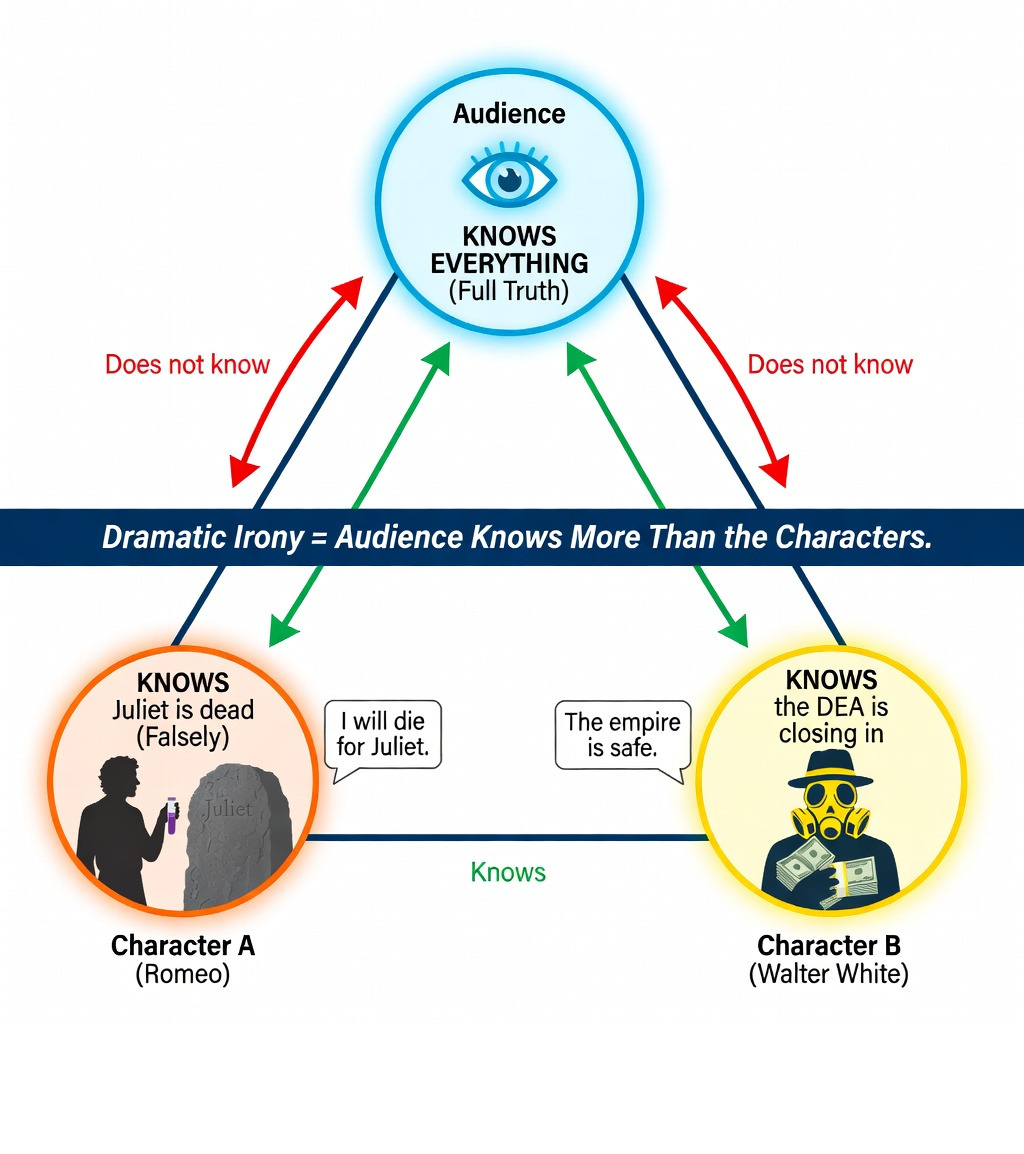
What is dramatic irony? It is a storytelling device where the audience knows something that the characters do not — and that gap in knowledge creates tension, suspense, or humor. Whether you are watching a high-stakes cooking competition at a Brooklyn screening or a classic play in Manhattan, this device is what keeps you on the edge of your seat.
Here is a quick answer:
Dramatic irony occurs when the audience has information a character lacks, making every scene more charged — because we can see what the character cannot.
At a glance:
- What it is: The audience knows a secret the character does not
- What it creates: Tension, suspense, dread, or comedy
- Where it appears: Literature, film, theater, television, and even culinary storytelling
- Classic example: In Romeo and Juliet, we know Juliet is alive. Romeo does not — and drinks poison anyway.
That feeling when you want to yell at the screen — “She’s not dead!” or “Don’t eat that secret ingredient!” — that is dramatic irony doing exactly what it is supposed to do.
It is one of the oldest tricks in storytelling, dating back to ancient Greek theater. And it still works just as well today, from Shakespeare to the high-pressure kitchens of The Bear or the drama of Breaking Bad.
This guide covers everything: the definition, the history, the best examples, and how to use it in your own writing, whether you’re crafting a novel or a food blog about the New York culinary scene.
What is dramatic irony vocab explained:
What is Dramatic Irony?

To truly understand what is dramatic irony, we have to look at the perspective of the observer. In any narrative, there are three main parties: the author, the characters, and the audience. Dramatic irony exists when the author lets us (the audience) in on a secret that the characters are still in the dark about. This creates a “privileged position” for us; we aren’t just watching the story unfold; we are anticipating the collision between what the character thinks is happening and what we know is actually happening. Think of it like being a food critic who knows the chef accidentally swapped the salt for sugar, while the unsuspecting diner takes a giant bite.
The roots of this technique are deep, stretching back to the 8th century BCE. The term itself comes from the Greek word eironeia, which originally referred to a character type in Old Comedy known as the eiron. The eiron was a clever underdog who would feign ignorance or play dumb to triumph over the alazon, a boastful, self-important braggart. By pretending not to know things, the eiron created a gap between appearance and reality.
In modern storytelling, we use this device to keep readers glued to their seats. When we know the killer is hiding in the pantry but the protagonist is calmly pouring a glass of milk, the tension becomes almost unbearable. Learn how dramatic irony adds suspense to your story by exploring how giving readers a “leg up” on the characters changes the entire emotional experience of a scene.
The Three Stages of Narrative Irony
Dramatic irony isn’t just a static “gotcha” moment; it is a structural process that unfolds across the narrative arc. We can break it down into three distinct stages:
1. The Preparation Stage (Exposition)
This is where the author “plants” the information. We see the villain place the poisoned apple on the desk, or we watch a chef in a Brooklyn kitchen accidentally drop a wedding ring into a batch of dough. At this stage, the audience is given the “key” to the irony. Without this preparation, the eventual reveal would just be a surprise, not irony.
2. The Suspension Stage (Complication)
This is where the bulk of the storytelling happens. The character continues their journey, making choices based on their limited knowledge. Every time they mention “how safe they feel” or “how much they trust” the person we know is a traitor, the irony deepens. In a culinary context, this is the diner praising the “unique crunch” of the bread while we wait for them to find the ring.
3. The Resolution Stage (Denouement)
Finally, the gap closes. The character discovers the truth that we have known all along. The impact of this stage depends on the genre. In a tragedy like Oedipus Rex, the resolution is devastating; in a comedy like The Office, it’s the moment of peak embarrassment.
Dramatic Irony vs. Other Types of Irony
It is easy to get confused between the different flavors of irony. While what is dramatic irony centers on the audience’s knowledge, other types focus on words or outcomes.
| Type of Irony | Core Mechanism | Example |
|---|---|---|
| Dramatic Irony | Audience knows more than characters. | We know the shark is under the boat; the swimmers don’t. |
| Verbal Irony | A character says the opposite of what they mean. | Eating a dry, overcooked steak and saying, “This is the juiciest meal I’ve ever had!” |
| Situational Irony | The outcome is the opposite of what was expected. | A world-renowned chef losing a local chili cook-off to a beginner. |
| Socratic Irony | Feigning ignorance to lure someone into a trap. | A teacher pretending not to know an answer to make a student explain it. |
| Cosmic Irony | The universe or “fate” seems to manipulate events. | A man survives a plane crash only to be hit by the ambulance. |
Verbal irony is often used for sarcasm, whereas situational irony relies on a twist of fate. Dramatic irony is unique because it relies entirely on the relationship between the storyteller and the audience.
Classic Examples Across Literature and Film
From the stages of Brooklyn’s local theaters to the screens of Manhattan’s cinemas, dramatic irony is the engine of many of our most beloved stories.
What is dramatic irony in literature?
Writers have used this tool for centuries to create “tragic irony”—a specific subtype where the audience sees a character’s downfall coming while the character remains blissfully unaware.
- Romeo and Juliet: Perhaps the most famous example. We know Juliet has taken a sleeping potion to fake her death. Romeo, arriving at the tomb, believes she is actually dead. His suicide is a direct result of this knowledge gap.
- Oedipus Rex: Sophocles was a master of this. Oedipus vows to find and punish the man who killed the former king, unaware that he is the killer he seeks. The audience watches him unknowingly curse himself.
- The Cask of Amontillado: In Poe’s story, The Cask of Amontillado, we are told from the very first paragraph that Montresor intends to kill Fortunato. As they walk through the catacombs, every “friendly” gesture Montresor makes is chilling to us, though Fortunato remains clueless.
- Macbeth: The audience knows Macbeth’s plan to murder King Duncan to fulfill the witches’ prophecy, but Duncan enters Macbeth’s castle feeling safe and welcomed.
- The Great Gatsby: Readers eventually learn the truth about Gatsby’s criminal background and his desperate efforts to recreate the past, while many characters in the book see him only as a mysterious, wealthy socialite.
What is dramatic irony in film and television?
In visual mediums, we can use camera angles and soundtracks to give the audience information that the characters on screen cannot see or hear.
- Titanic: This is a unique case where the entire movie is a form of dramatic irony. We know the ship is going to sink before we even buy our popcorn. Every scene of the characters talking about the “unsinkable” nature of the vessel carries a heavy weight of irony.
- Jaws: Think of the music. When we hear that famous “dun-dun, dun-dun,” we know the shark is near. The swimmers in the water don’t hear the non-diegetic music, so they stay in the water while we grip our armrests.
- The Truman Show: We are in on the secret from the start—Truman’s entire life is a television show. Every interaction he has with “friends” or “family” is viewed through the lens of our superior knowledge.
- Breaking Bad: We watch Walter White’s secret life as a meth kingpin unfold while his family, including his DEA agent brother-in-law, remains oblivious for seasons.
- The Office: The mockumentary format is a goldmine for dramatic irony. Characters often reveal their true, often contradictory, thoughts in private interviews, which then play out against their public actions in the office.
We even see dramatic irony in the art world. New York artist Chloe Wise famously used this concept with her “Bagel No. 5” sculpture. In 2014, a model wore what looked like a high-fashion Chanel bag to a premiere—but it was actually a hyper-realistic sculpture of a bagel with cream cheese. The media frenzy that followed was a real-life example of dramatic irony: the audience (the press) thought they were looking at “carb couture” luxury, while the artist and those “in the know” knew it was a satirical art piece.
How to Use Dramatic Irony in Storytelling
Whether you are writing a play for a local Manhattan theater, a screenplay set in the streets of Brooklyn, or a food review for a New York publication, using dramatic irony effectively requires a delicate touch. Here is how we recommend approaching it:
1. Decide the Information Gap
What does the audience need to know? It should be something significant—a secret, a hidden danger, or a true identity. If the information is trivial, the irony won’t have any impact.
2. Expose the Character’s Ignorance
Show, don’t just tell, that the character doesn’t know. Have them make plans for a future we know won’t happen, or trust someone we know is a villain. This highlights their vulnerability.
3. Use Medium-Specific Techniques
- On Stage: Use monologues or “asides” where a character speaks directly to the audience. You can also use “timed dialogue” where one character enters or leaves a room just as a secret is revealed.
- On Screen: Use visual juxtaposition. Show a close-up of a ticking bomb under a table while two characters calmly discuss their lunch plans at a trendy Manhattan bistro. This “Hitchcockian” approach is the gold standard for suspense.
- In Prose: Use different viewpoints. Intersperse chapters from the hero’s perspective with chapters from the villain’s perspective. This gives the reader a bird’s-eye view of the impending conflict.
4. Build Empathy
Dramatic irony is a great way to make us care about a character. When we see someone walking into a trap, our natural instinct is to want to help them. This creates a powerful emotional bond between the reader and the protagonist.
Common Pitfalls When Using Dramatic Irony
While it is a powerful tool, it can backfire if not handled correctly. Avoid these common mistakes:
- Inconsequential Information: If the audience knows the character has a hole in their sock but it never affects the plot, it isn’t effective irony. The secret must have consequences.
- The “Unfired” Chekhov’s Gun: If you give the audience a piece of information, you must eventually resolve it. If the character never finds out the truth, the audience feels cheated.
- Over-Explaining: Don’t hit the audience over the head with the irony. If we already know the secret, you don’t need to have a narrator remind us every five minutes. Trust your audience’s intelligence.
- Spoiling the Mystery: Sometimes, a “twist” is better than irony. If the joy of your story is the surprise, don’t use dramatic irony. Irony is about anticipation, not shock.
- Audience Frustration: If a character stays ignorant for too long despite obvious clues, they can start to look “too dumb to live,” which makes the audience lose respect for them.
Frequently Asked Questions about Dramatic Irony
What is tragic irony?
Tragic irony is a specific type of dramatic irony used in tragedies. It occurs when the audience is aware that a character’s actions are leading directly to their downfall, but the character remains unaware. It is often linked to a character’s hamartia or tragic flaw. Think of Oedipus or Macbeth—we see the disaster coming, but they are driven by fate or ambition toward their own end.
Is dramatic irony the same as foreshadowing?
They are related but different. Foreshadowing provides hints or clues about what might happen later in the story (e.g., a character mentioning they have a bad feeling about a storm). Dramatic irony involves the audience having concrete knowledge that the character lacks right now. Foreshadowing builds a sense of “what if,” while dramatic irony builds a sense of “when will they find out?”
Can dramatic irony be used in nonfiction writing?
Yes, particularly in narrative nonfiction like memoirs, biographies, or historical accounts. Since the reader often knows how history turned out (e.g., we know a certain political movement will fail or a famous figure will die young), the writer can frame the subject’s hopeful or unaware actions with a layer of irony. However, we must be careful not to distort facts or make historical figures look artificially ignorant just for the sake of drama.
Conclusion
At Edible Brooklyn, we believe that every great meal tells a story, and every great story needs a bit of tension to keep things interesting. Whether you are exploring the vibrant food scene in Manhattan or enjoying the quiet beauty of the Catskills, understanding the mechanics of storytelling like what is dramatic irony helps us appreciate the culture and creativity around us.
Dramatic irony is more than just a literary term; it is a way to bridge the gap between the creator and the audience, turning a passive observer into an active participant who is emotionally invested in the outcome. By giving us the “inside scoop,” writers and creators ensure that we stay engaged, whether we are laughing at a misunderstanding in a Brooklyn sitcom or gripping our seats during a thriller set on the streets of New York.
Ready to see some drama (and maybe some irony) in action? Explore the best restaurants in Brooklyn and see how local chefs are telling their own stories through unique ingredients and local culinary culture.
