


Why Adults Love (and Sometimes Fail) the Fifth-Grade Challenge
Are you smarter than a 5th grader questions have stumped adults for years, turning elementary school trivia into surprisingly humbling entertainment. These questions cover subjects like math, science, history, and grammar—all at a level that ten and eleven-year-olds master in school.
Quick Answer: Sample Questions by Subject
- History: Who was the 16th president of the United States? (Abraham Lincoln)
- Science: What is the closest planet to the sun? (Mercury)
- Math: What is ⅓ of 90? (30)
- Geography: How many continents are there? (Seven)
- Grammar: What is the plural of “moose”? (Moose)
The premise is simple: contestants face questions pulled straight from elementary school curriculum, with the chance to win up to $1 million by proving they remember what they learned decades ago. The original game show aired over 3,000 episodes globally, and only two adults ever claimed the top prize. That’s because somewhere between fifth grade and adulthood, most of us forget basic facts—like which river separates the U.S. and Mexico, or how many bones are in the human body.
Week after week, the show made viewers question whether they should go back to school. It’s a nostalgic trip to childhood classrooms mixed with the thrill of competition. The questions aren’t designed to be trick questions (though some certainly feel that way). They’re straightforward recall of fundamental knowledge that somehow slips away as we age.
This list brings together questions across all major subjects, organized by grade level and topic. Whether you’re planning a trivia night, testing your own memory, or just curious if you’d make it past the first round, these questions offer a fun way to revisit what you learned (or forgot) from your school days.
Test Yourself: Are You Smarter Than a 5th Grader Questions by Subject
We’ve all been there: staring at a child’s homework, scratching our heads, and wondering if we ever actually learned this stuff. The ‘Are You Smarter Than a 5th Grader?’ game show brilliantly capitalized on this universal adult experience. It highlighted a fascinating phenomenon: how easily we can overthink simple facts or completely forget fundamental curriculum we once knew.
One of the most common mistakes adults make when faced with are you smarter than a 5th grader questions is overthinking. We tend to look for complex answers, assuming the question must have a hidden layer of difficulty. But elementary school questions are often direct, requiring simple recall. Another frequent pitfall is simply forgetting. As we specialize in our careers and daily lives, basic facts about science, history, or grammar can fade into the background.
So, are you ready to put your knowledge to the test? Challenge your friends, family, or even yourself with these questions designed to stretch your memory muscles.
History & Social Studies
History and social studies questions often revolve around key figures, major events, and the foundational aspects of government and civilization. From ancient empires to pivotal moments in American history, fifth graders are expected to grasp a broad timeline of human achievements and societal structures.

A typical fifth-grade history curriculum in the U.S. will cover topics like the American Revolution, the Civil War, the Constitution, and basic civics. They’ll learn about important leaders and the origins of significant cultural practices. For instance, do you remember which document starts with “We the People”? Or who gave the Gettysburg Address?
Let’s explore some history and social studies questions that might appear on the quiz:
- Q: The first Thanksgiving was celebrated by Native Americans and what other group of people?
A: Pilgrims - Q: Who invented the lightbulb in 1879?
A: Thomas Edison - Q: Neil Armstrong and Buzz Aldrin were the first two men in the entire world to do what?
A: Walk on the moon - Q: What are the three branches of the United States government?
A: Legislative, judicial, and executive - Q: Which war was fought between the North and South in the United States?
A: The Civil War - Q: What are the first 10 amendments to the Constitution called?
A: The Bill of Rights - Q: Julius Caesar was the emperor of what empire?
A: The Roman Empire - Q: What is Rosa Parks most famous for?
A: Refusing to give up her seat in the front of the bus - Q: The first fireworks were invented in the 7th century in what country?
A: China - Q: What ancient civilization built the Machu Picchu complex in Peru?
A: The Incas - Q: What was the ancient Egyptian writing system called?
A: Hieroglyphics - Q: Who wrote the national anthem of the United States of America?
A: Francis Scott Key - Q: How many stars are on the American flag?
A: 50 - Q: The Statue of Liberty was a gift from what country?
A: France - Q: According to the U.S. Constitution, the president is part of which of the three branches of government?
A: Executive - Q: Who was the 16th president of the United States?
A: Abraham Lincoln - Q: What’s the name of the first African American baseball player?
A: Jackie Robinson - Q: Christopher Columbus made his 1492 transatlantic voyage under the sponsorship of Ferdinand and Isabella, who were the king and queen of what country?
A: Spain - Q: What did colonists famously toss into the Boston Harbor in 1774?
A: Tea - Q: During what war did the British troops set the White House on fire?
A: The War of 1812
Science
Fifth-grade science covers everything from the vastness of space to the smallest living organisms. Students learn about the human body, Earth’s systems, basic physics, and the natural world around them. It’s about understanding how things work and why.
- Q: What’s the name of the closest star to Earth?
A: The Sun - Q: What’s the freezing point of water in Celsius?
A: 0 degrees - Q: Which ocean is the biggest?
A: Pacific Ocean - Q: Which planet is known as the “Red Planet”?
A: Mars - Q: How many bones are in the human body?
A: 206 - Q: What is the longest river in the world?
A: The Nile River - Q: Which natural disaster is measured using the Richter scale?
A: Earthquake - Q: What is the largest organ in the human body?
A: Skin - Q: What is the study of plants called?
A: Botany - Q: What causes ocean tides?
A: The moon - Q: What is the force that causes objects to fall to the ground?
A: Gravity - Q: What is the largest internal organ in the human body?
A: The liver - Q: Earth is located in what galaxy?
A: The Milky Way - Q: What phenomenon might be felt on the Earth’s surface when two tectonic plates rub against each other?
A: An earthquake - Q: The hardest naturally occurring mineral is __.
A: Diamond - Q: The process by which plants “eat” and make energy is called __.
A: Photosynthesis - Q: What is the part of the eye that controls how much light enters?
A: The pupil - Q: How long does it take Earth to orbit once around the sun?
A: 365 days - Q: The Earth is at least how many billion years old?
A: 4 billion - Q: What are the three states of matter?
A: Solid, liquid, and gas - Q: The Earth has four layers, the thickest of which is the mantle. What is the thinnest layer called?
A: The crust - Q: Animals without backbones are known as __.
A: Invertebrates - Q: What species can live both in water and on land?
A: Amphibians
Math
Math questions in fifth grade cover a range of essential skills, from basic arithmetic and fractions to geometry and word problems. These are the building blocks for more complex mathematical concepts, and sometimes, the simplest ones are the easiest to forget if you’re not using them daily.
Many adults find themselves stumped by math questions that require mental calculation or a quick recall of formulas they haven’t touched since elementary school. The key here is often to break down the problem and remember the fundamental principles.
- Q: If you have 3 quarters, 4 dimes, and 5 nickels, how much money do you have?
A: $1.45 (75¢ + 40¢ + 25¢ = $1.45) - Q: How many degrees are in a right angle?
A: 90 degrees - Q: If a recipe calls for 3/4 cup of flour and you want to double the recipe, how much flour do you need?
A: 1 1/2 cups (3/4 × 2 = 6/4 = 1 1/2) - Q: What is the sum of all angles in a triangle?
A: 180 degrees - Q: If you save $5 each week, how much will you have saved after 1 year (52 weeks)?
A: $260 (5 × 52 = 260) - Q: If a pizza is cut into 8 equal slices and you eat 3 slices, what fraction of the pizza did you eat?
A: 3/8 - Q: If a class has 24 students and 3/8 of them are boys, how many boys are in the class?
A: 9 boys (3/8 × 24 = 9) - Q: If a pen costs $1.25 and you buy 4 pens, how much change will you get from a $10 bill?
A: $5.00 (10 – (1.25 × 4) = 10 – 5 = 5) - Q: If a car travels at 55 miles per hour, how far will it travel in 3 hours?
A: 165 miles (55 × 3 = 165) - Q: If you start with the number 36 and divide by 4, then multiply by 2, what number do you get?
A: 18 ((36 ÷ 4) × 2 = 9 × 2 = 18) - Q: If you flip a coin, what is the probability of getting heads?
A: 1/2 or 50% - Q: If a bus leaves at 2:45 PM and arrives at 4:15 PM, how long was the bus ride?
A: 1 hour and 30 minutes (90 minutes) - Q: When rounded to the nearest ten, what is 347?
A: 350 - Q: If a box contains 2 dozen pencils, how many pencils are there?
A: 24 pencils (2 × 12 = 24) - Q: What is the highest two digit even number?
A: 98 - Q: How many centimeters are in three and a half meters?
A: 350 - Q: If Posie ate ½ the pie and Chris ate ⅛ the pie, how much is left?
A: ⅜ of the pie - Q: How many inches are there in two yards?
A: 72 inches - Q: If a shopping cart has one kiwi, two bananas, three pineapples and four cookies, what percentage of the cart’s total contents is fruit?
A: 60% - Q: If a football field is 100 yards long, how many feet long is the football field?
A: 300 feet
English, Grammar & Spelling
From identifying parts of speech to correctly punctuating sentences and understanding figurative language, fifth graders are expected to have a solid grasp of the English language. These questions test our foundational knowledge of how words work together and how to communicate effectively. It’s surprising how often we rely on autocorrect these days and forget the basics!
- Q: Correctly punctuate this sentence: “I like cooking my sister and my cat.”
A: I like cooking, my sister, and my cat. - Q: Identify the adverb in this sentence: “Sarah danced beautifully at her recital.”
A: Beautifully - Q: Where do the commas belong in this date sequence? Tuesday April 24th 2001
A: Tuesday, April 24th, 2001 - Q: Is this sentence about permission or ability? “Can you play the drums?”
A: Ability (“May I play the drums?” asks for permission.) - Q: The figurative language in this sentence is called what? “He has a heart of gold.”
A: A metaphor - Q: What is the root word of the word “indecision”?
A: Decide - Q: The plural of “moose” is __.
A: Moose - Q: In the story about the boy who cried wolf, what is the lesson?
A: Always tell the truth - Q: What is the term for a word that is similar in meaning to another word?
A: Synonym - Q: What type of words should always be capitalized?
A: Proper nouns - Q: Is “red” an adjective or a noun?
A: Both - Q: What are the five interrogative or “question” words?
A: Who, what, when, where, and why - Q: What are the comparative and superlative forms of the word “big?”
A: Bigger and biggest - Q: The person in a novel who tells the story from a third-person perspective is called a what?
A: The narrator - Q: What is the name of the book about a friendship between a spider and a pig named Wilbur?
A: Charlotte’s Web - Q: Who is the author of James and the Giant Peach?
A: Roald Dahl - Q: The main series of events in a story is called a what?
A: The plot - Q: What is the main character in a story called?
A: The protagonist - Q: A story conveying a moral lesson is called what?
A: A Fable - Q: What do you call a group of crows?
A: A murder - Q: Who is the creator of the classic book characters Tom Sawyer and Huckleberry Finn?
A: Mark Twain - Q: The words “the,” “an,” and “a,” are known as what in English grammar?
A: Articles - Q: Who is the author of the 1960 novel about social and racial inequality To Kill a Mockingbird?
A: Harper Lee - Q: Often seen at the end of a sentence, the three trailing dots that indicate the omission from speech or writing of a word (or words) that is superfluous or able to be understood from contextual clues are known as __.
A: An ellipsis - Q: What is the name of the most famous English playwright?
A: William Shakespeare
Behind the Scenes: The Enduring Appeal of the Quiz
The enduring popularity of the ‘Are You Smarter Than a 5th Grader?’ format lies in its unique blend of nostalgia, humor, and genuine challenge. It taps into our collective memory of elementary school, reminding us of the foundational knowledge we once held dear. This quiz format has become a staple in pop culture, inspiring countless family game nights, school competitions, and online quizzes. It’s a wonderful way to bring people together, sparking conversations and laughter over forgotten facts.
Hosts, Prizes, and Memorable Winners
The original ‘Are You Smarter Than a 5th Grader?’ game show, which debuted on Fox in 2007, was hosted by comedian Jeff Foxworthy. His folksy charm and witty banter made the humbling experience of adults struggling with basic questions all the more entertaining. The show was later rebooted by Nickelodeon with John Cena as host, bringing a new energy to the classroom. In a more recent spin-off, ‘Are You Smarter Than a Celebrity,’ contestants team up with famous athletes, singers, and actors for a shot at a $100,000 grand prize.
The grand prize on the original show was a life-changing $1 million, but achieving this feat was incredibly rare. Throughout the original run, only two adults won the top prize: Kathy Cox, the Georgia State School Superintendent, and a Nobel Prize-winning physics professor. Their victories underscored the show’s premise that specialized knowledge doesn’t always guarantee recall of elementary school facts and that basic knowledge is more elusive than we think.
The Role of the “Classmates”
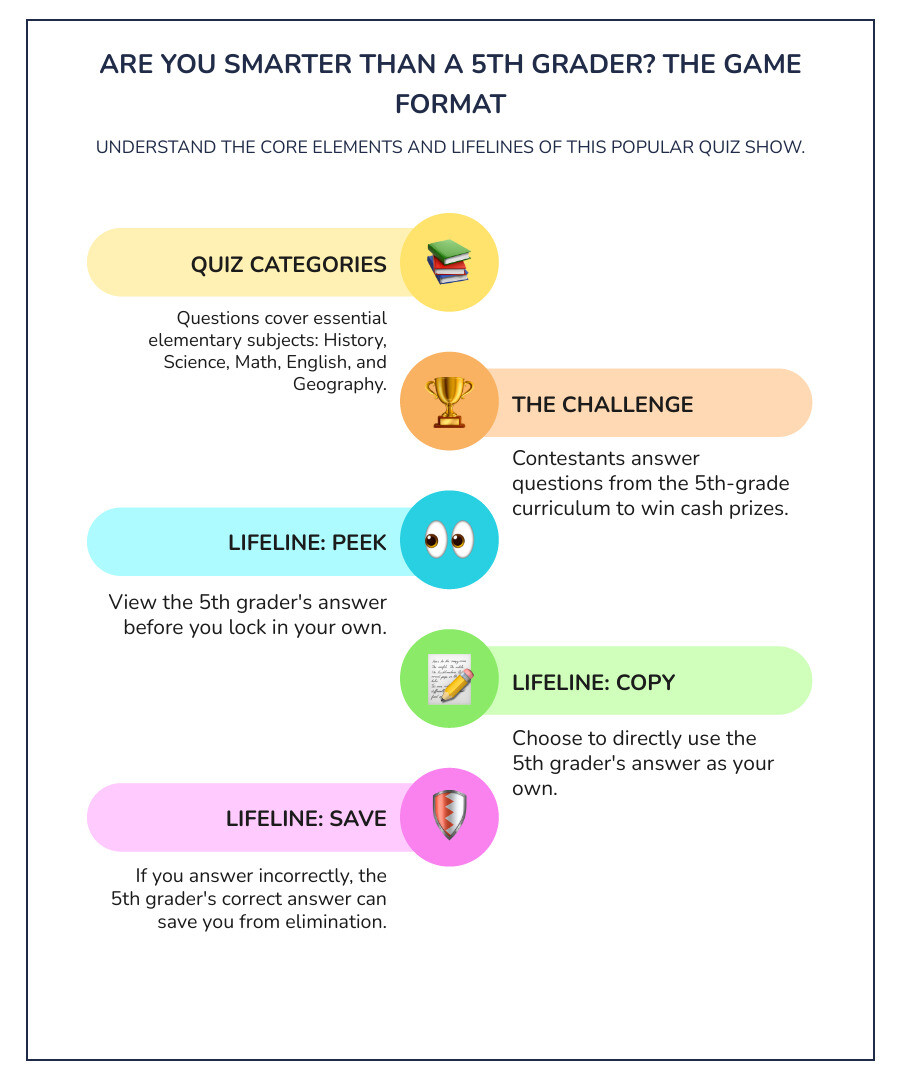
A unique and charming aspect of the show was the inclusion of actual fifth-grade students. These bright young minds weren’t just there for moral support; they were an integral part of the gameplay. Contestants could choose one of their “classmates” to help them answer a question, using “cheats” like “Peek,” “Copy,” or “Save.”
- Peek: The contestant could look at the student’s answer.
- Copy: The contestant had to use the student’s answer as their own.
- Save: If the contestant answered incorrectly, and the student’s answer was correct, the contestant was “saved.”
The students themselves became minor celebrities. Many of these young talents went on to pursue acting careers. For example, Laura Marano, known for ‘The Royal Treatment’ and ‘Austin & Ally,’ and Sierra McCormick from ‘American Horror Stories’ were both fifth-grade classmates on the show. Their presence added an authentic touch, reminding adults that these questions were indeed within the grasp of a ten-year-old.
Frequently Asked Questions
Has anyone ever won the $1 million in this quiz format?
Yes, two contestants won the $1 million prize on the original ‘Are You Smarter Than a 5th Grader?’ show: Kathy Cox, a State School Superintendent, and George Smoot, a Nobel Prize-winning physicist. Their victories proved it was possible, though very difficult, to retain enough elementary school knowledge to reach the ultimate prize.
What are the hardest ‘are you smarter than a 5th grader questions’ for adults?
The questions that typically stump adults the most are those that require rote memorization of facts or basic rules that we no longer actively use. These often include:
- Specific dates in history: Recalling exact dates, like the year the Bill of Rights was ratified (1791), can be tough even if we remember the major events.
- Basic grammar rules: Identifying parts of speech or applying punctuation rules often stumps adults who rely on spellcheck in their daily lives.
- Simple math conversions: Questions involving fractions or converting units like yards to feet can be tricky without recent practice.
- Forgotten science facts: Remembering details like the number of bones in the human body (206) isn’t common knowledge for most adults.
- Overthinking: Adults often look for a trick in a straightforward question, making it harder than it is.
The difficulty isn’t usually in the inherent complexity of the material, but in the recall of facts learned decades ago and the tendency to overthink what should be straightforward.
How can I play ‘are you smarter than a 5th grader questions’ at home?
Playing are you smarter than a 5th grader questions at home is a fantastic way to entertain, educate, and challenge your friends and family. Here’s how we recommend you do it:
- Host your own trivia night: Gather your loved ones in your Brooklyn or Manhattan home, perhaps with some delicious local snacks from Edible Brooklyn, and use this very list of questions as your quiz master’s guide! You can even assign “classmates” to each adult contestant.
- Create printable quiz sheets: Print out sections of these questions by subject, or mix and match for a diverse challenge. Hand them out at gatherings or dinner parties for a fun, low-pressure competition.
- Online quizzes and apps: While we’ve provided a comprehensive list here, many websites and apps offer similar quizzes. A quick search for “are you smarter than a 5th grader quiz online” will yield plenty of options.
- Family challenges: Make it a weekly tradition. Each week, a different family member can be the “5th grader” and pose questions to the adults. It’s a great way to bond and see who truly remembers their elementary school lessons!
The beauty of these questions is their accessibility. They don’t require specialized equipment or extensive preparation, just a willingness to test your knowledge and have a good laugh at what you might have forgotten.
Conclusion: Did You Make the Grade?
After diving deep into these are you smarter than a 5th grader questions, we hope you’ve had a fun and perhaps humbling trip down memory lane! It’s a wonderful reminder that the foundations of knowledge we gain in elementary school are both vast and, sometimes, surprisingly fragile in our adult minds. The game show’s enduring popularity, from its original run to reboots and celebrity spin-offs, speaks to our shared human experience of learning, forgetting, and the universal challenge of proving we’re still “smart enough.”
Whether you aced every question or found yourself reaching for a “cheat” sheet, the spirit of the quiz is all about engagement and the joy of findy. It encourages us to keep learning, keep questioning, and maybe even brush up on those long-forgotten facts.
Here at Edible Brooklyn, we believe in celebrating the richness of our local culture, from the vibrant food scene to the intellectual curiosities that bring us together. After all that brain work, why not treat yourself? Explore our guide to local seafood and savor some of the freshest catches from our incredible New York waters. You’ve earned it!
