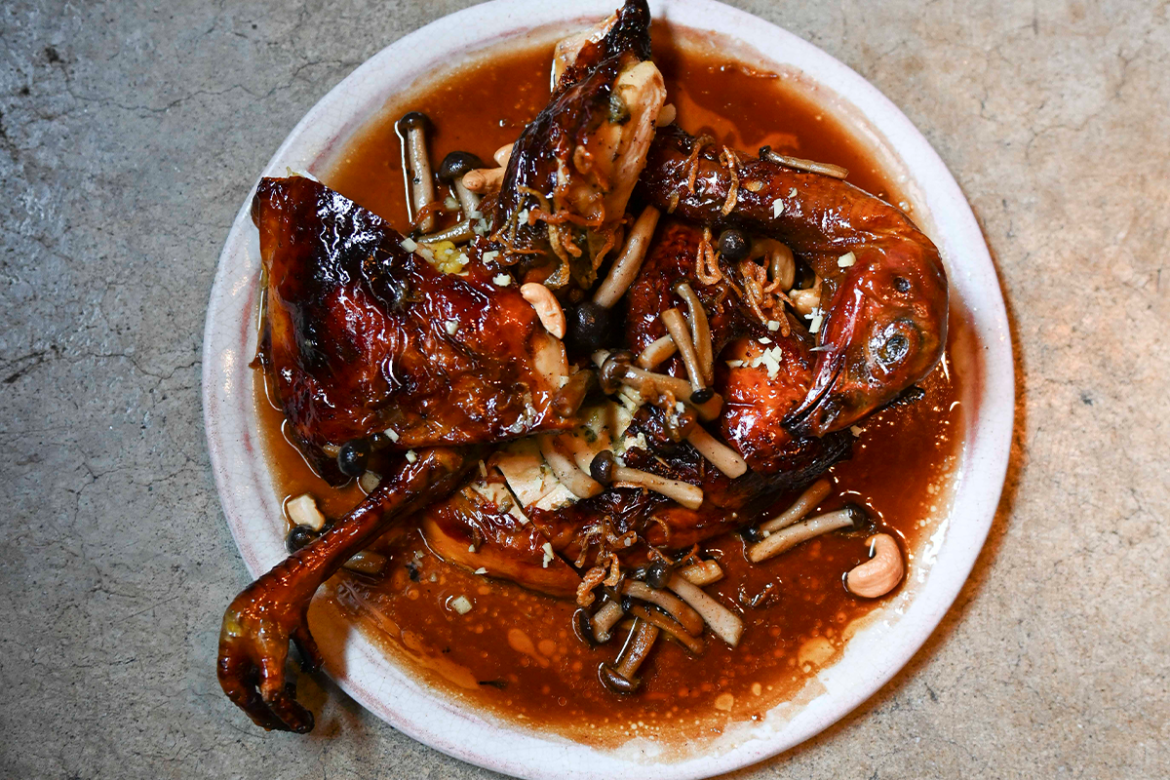
The grilled, citrus-marinated chicken with hot sauce has been a perennial topseller at Crown Shy, the Michelin-starred Lower Manhattan restaurant, ever since it opened in 2019. The bird arrives at the table with its skin bronzed and glazed with a citrus gastrique. Its meat is juicy and piquant from a habanero-infused brine. Its foot is crisp and filled with gelatinous tendons. Yes, its foot, which hangs off the plate at the end of the neatly cut leg piece, claws gently curled.
For many New Yorkers, it’s a jarring sight. For much of the world, it’s just what chickens look like.
“You’d be surprised by how many people are surprised that chickens have feet,” laughs Executive Chef Jassimran Singh, who collaborated on the dish’s creation along with the rest of Crown Shy’s opening kitchen staff, including its late chef, Jamal James Kent.

From soy sauce chickens hanging inside Chinatown butcher shops to rotisserie chickens dripping from windows in Washington Heights’ Dominican eateries, whole chickens are everywhere in New York—and they’re commanding greater cachet amongst the city’s fine dining restaurants. Rotisserie chickens have become destination dining as chefs increasingly treat what was once considered a humble Sunday supper with the same reverence reserved for steak or seafood.
Feet-on Chickens
Some are taking that respect a step further by featuring the feet—and sometimes the head—in their restaurant dishes and online recipes. Though chicken feet are enjoyed widely across Asian cuisines, they’re still a rarity in the Michelin-starred space, where they’ve become a marker of authenticity, careful sourcing, and a nose-to-tail sense of sustainability.
At Kabawa, the Caribbean three-course prix-fixe restaurant in Nolita, Chef Paul Carmichael serves a Calypso half chicken special inspired by a dish from Dominica, glazed with allspice, ginger, red wine, and guava. The birds, which he sources from Fortune Meat Market in Manhattan’s Chinatown, have enough fat to suit the drying and roasting process used by their kitchen. They’re served in pieces on the bone, including the sauce-lacquered feet, head, and neck.
“In the Caribbean, we eat heads and feet, we eat liver and pig foot, and snout and ears,” says Carmichael. “If that’s a part of our culture, even if the newer generation of people from the region don’t even want to touch that, I think there needs to be a space for preservation.”
Besides, he says, chicken feet are delicious; his favorite part of them is the fleshy pad in the center.
“I want to do the things that I want to do in a respectful and delicious way,” Carmichael said. “I’m just asking people to come in with an open mind.”
Only one diner has ever asked for the feet to be removed.

At Crown Shy, Singh estimates his kitchen sells around 250 chickens each week, which are sourced from Hudson Valley Farm. About 80 percent of diners think the presentation is “cool,” Singh says. The remainder are either fascinated or initially squeamish.
“I was like, ‘let’s just lean into it,’” he says. “If you’re doing something bold, let people either hate us for this chicken or love us for the chicken.”
Minimizing Waste
The feet also reinforce another goal: minimizing waste. While bones become stock and jus, separate chicken feet are simmered into a collagen-rich consommé that sets into the gelée served atop the restaurant’s oysters. “The goal was to use the whole animal as much as we can,” Singh says. “That’s respecting the bird.”
Having the feet, head, and neck intact gives you more “possibilities”—for sauces, stocks, and more, explains Alexia Duchêne, chef of the French restaurant Le Chêne in the West Village. “The most important part of shopping for chickens is looking for head-on, feet-on, and golden color,” she advises.
She remembers being dismayed after moving to the United States three-and-a half years ago by the pale, mass-produced chickens lining supermarket shelves. “They were translucent, white,” she said. “It kind of grossed me out.”
Today she seeks out slower-growing birds from Pennsylvania at local butchers like Dickson’s Farmstand. Last spring, in a recipe and video tutorial for Bon Appétit, she advised home cooks to keep the feet on when roasting a chicken.
But finding those birds isn’t always easy. According to Tom Super of the National Chicken Council, chicken “paws” are almost always removed during commercial processing. The overwhelming majority are exported to China, Hong Kong, and Vietnam, where they’re prized for braised dishes and dim sum. Others become pet treats.
That scarcity makes foot-on chickens an indicator of smaller-scale production. “If you’re choosing head and feet on, your options are limited,” said Anita Lee, co-owner of Bo Bo Poultry Market, whose New York State farm supplies many Chinatown retailers and a growing number of fine-dining restaurants. The family-owned business specializes in slower-growing French breeds, processed with their heads and feet intact, a style rooted in cultural traditions rather than restaurant aesthetics.

Across Chinese communities, whole chickens symbolize completeness, prosperity, and family unity during celebrations ranging from Lunar New Year to birthdays and ancestral offerings.
“You always want to start an event with a complete whole chicken,” says Lee. “Cutting it up before offering is seen as breaking up that unity.”
As social media rewards visually striking dishes, the intact bird, claws and all, has become an attention-grabbing centerpiece. But for the chefs embracing it, the decision goes deeper than shock value.
It’s about honoring traditions that long predate fine dining, preserving cultural foodways, and reminding diners that chicken comes from an actual animal rather than a shrink-wrapped supermarket package.
For Kabawa’s Carmichael, that’s worth the occasional raised eyebrow.
“When something’s tasty enough,” he says, “it makes you try to explore it more.”