

Why Driving Modes Matter for Your Electric SUV Journey
Do the driving modes in Cadillac Lyriq offer different ranges or battery usages? Yes, they do. The Cadillac Lyriq’s driving modes directly affect how your vehicle uses energy and, consequently, how far you can travel on a single charge.
Quick Answer:
- Tour Mode provides the best range through smooth, conservative power delivery and optimized efficiency
- Sport Mode reduces range by prioritizing sharper acceleration and dynamic performance
- Snow/Ice Mode slightly affects battery usage by adjusting power delivery for traction control
- My Mode allows custom settings that can impact efficiency based on your preferences
- The modes don’t change your battery’s capacity (102 kWh), but they alter how quickly that energy is consumed
If you’re planning a culinary adventure across Brooklyn or a weekend escape to the Hudson Valley, understanding how your Lyriq’s driving modes affect range becomes essential. The difference between arriving at that hidden-gem restaurant or searching for a charging station often comes down to smart mode selection.
The Lyriq offers distinct driving experiences through its modes: Tour for daily efficiency, Sport for spirited driving, Snow/Ice for winter confidence, and My Mode for personalized preferences. Each mode adjusts throttle response, regenerative braking intensity, and traction control—all of which influence how much battery power you’re using at any given moment.
Your RWD Lyriq offers up to 326 miles of EPA-estimated range, while AWD models provide up to 319 miles. But these numbers shift based on which mode you select and how you drive. Tour mode maximizes that range potential, while Sport mode sacrifices efficiency for performance.
Understanding Your Lyriq’s Driver Mode Selector
The Cadillac Lyriq isn’t just a stunning electric SUV; it’s a smart one, too. At the heart of its adaptability is the Driver Mode Selector, a feature that allows us to tailor the vehicle’s performance to our preferences or the prevailing road conditions. Whether we’re navigating the busy streets of Manhattan or cruising along a scenic route in the Catskills, these modes empower us to optimize our driving experience.
The Driver Mode Selector, often accessible via the Lyriq’s impressive 33-inch diagonal continuous display, isn’t just a gimmick. It’s a sophisticated system that adjusts various vehicle parameters, including acceleration, suspension (where applicable), steering, and traction control. This means that with a simple tap or turn, we can transform the Lyriq’s personality, affecting everything from how quickly it responds to our foot on the pedal to how much energy it consumes.
Let’s explore the core modes that define the Lyriq’s versatile character.
Tour Mode: The Everyday Efficiency Champion
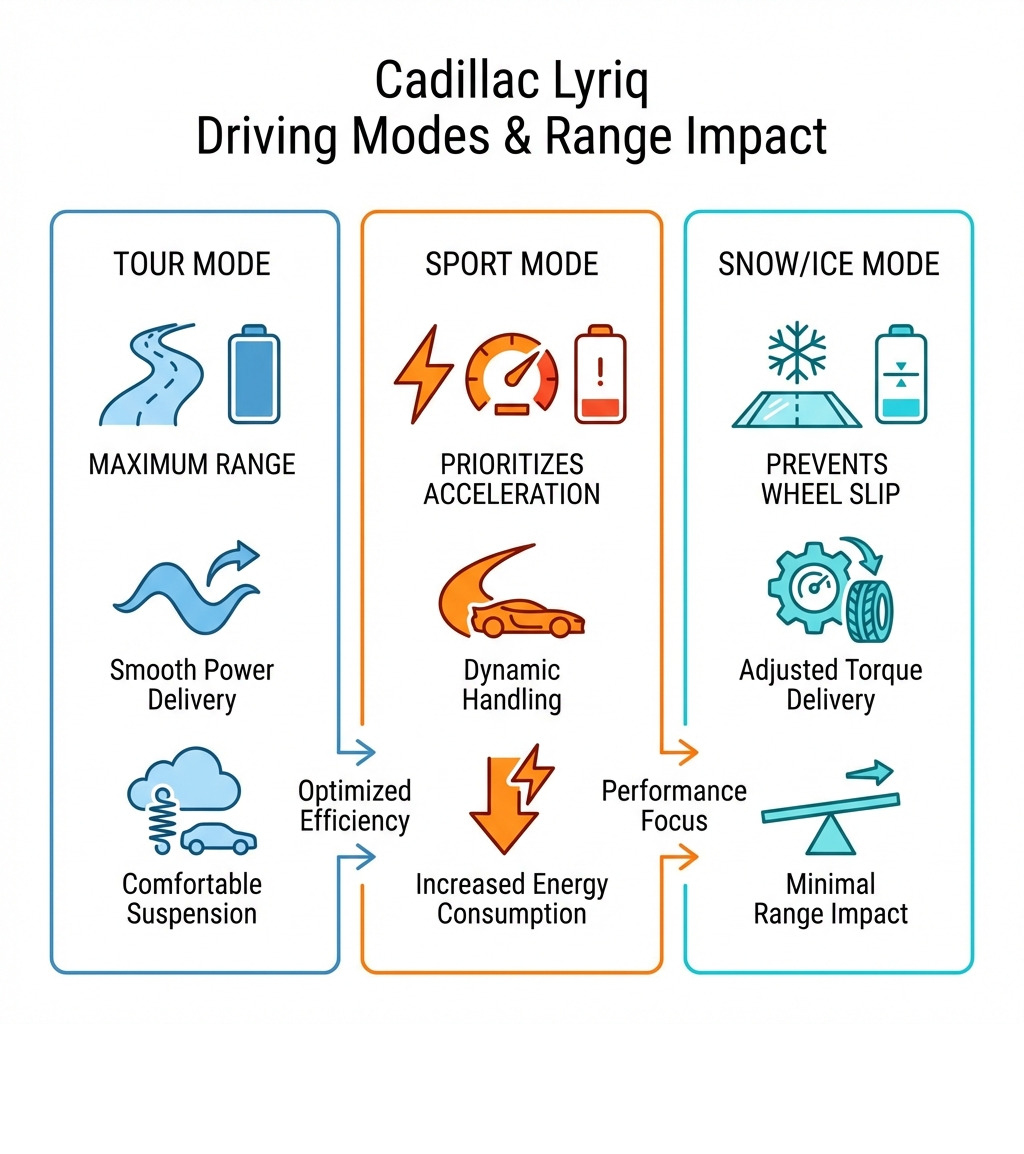
Think of Tour Mode as the Lyriq’s default, most balanced, and arguably most sensible setting for everyday driving. When we’re running errands in Brooklyn, commuting to work, or simply enjoying a relaxed drive, Tour Mode is our go-to. It’s designed to provide normal acceleration and comfortable ride tuning, ensuring a smooth and pleasant journey.
The magic of Tour Mode, from an efficiency perspective, lies in its calibrated power delivery. It prioritizes a smoother, more conservative throttle response. This means that while the Lyriq still feels responsive, it avoids sudden, power-hungry bursts of acceleration unless we explicitly demand them. This conservative approach to power delivery directly contributes to better battery usage and, consequently, the best possible range for our electric adventures. For those of us looking to maximize how far our Lyriq can take us, Tour Mode is unequivocally the efficiency champion.
Sport Mode: Releasing Performance
Now, if we’re looking to release a bit more of the Lyriq’s inherent power and dynamic capabilities, Sport Mode is where the fun begins. This mode transforms the vehicle into a more aggressive, performance-oriented machine, ideal for those moments when we crave a more engaging drive—perhaps on an open stretch of road outside the city, where we can truly appreciate its responsiveness.
In Sport Mode, we’ll immediately notice a few key adjustments. The steering response becomes tightened, offering a more direct and precise feel. The suspension tuning (if equipped) becomes firmer, enhancing handling and reducing body roll. Most importantly for our discussion, the engine calibration becomes more responsive. This means sharper acceleration and a quicker, more immediate delivery of the Lyriq’s impressive horsepower and torque.
However, there’s a trade-off, and it’s an important one for EV owners: Sport Mode sacrifices efficiency for performance. That exhilarating, fun-to-drive experience comes at the cost of increased battery consumption. While it’s fantastic for dry roads and spirited driving, we should expect a reduced range compared to Tour Mode. It’s a choice between maximizing thrills and maximizing miles.
Snow/Ice Mode: Confidence in Slippery Conditions
New York winters can be unpredictable, from slushy city streets to icy backroads in the Catskills. This is where Snow/Ice Mode becomes our trusted ally. This specialized driving mode is engineered to improve safety and control when navigating slippery road surfaces.
The primary adjustment in Snow/Ice Mode is to the pedal map, which directly influences throttle response and torque delivery. The system slows down both acceleration and torque response, making the Lyriq less prone to wheel slip. This controlled power output is crucial for maintaining traction and preventing skids on snow, ice, or wet roads. It allows for a more gradual and predictable application of power, giving us greater confidence and stability.
While its primary purpose is safety and traction, Snow/Ice Mode also has a slight, positive effect on battery usage. By moderating power delivery, it inherently reduces sudden power draws, which can contribute to slightly better efficiency in challenging conditions. It’s not designed as a range-extending mode, but its efficiency-minded adjustments can help us conserve energy when we need it most.
My Mode: Your Personalized Driving Experience
One of the most exciting aspects of the Lyriq’s Driver Mode Selector is the inclusion of “My Mode.” This isn’t just a preset; it’s a canvas for our personal driving preferences. My Mode is a configurable setting that truly allows us to customize various aspects of our Lyriq’s performance.
With My Mode, we can dive into the center display and fine-tune parameters such as steering feel, braking feel, acceleration feel and responsiveness, and even the motor sound. This level of customization means we can create a driving profile that perfectly matches our daily commute, a specific type of road, or just our mood. For instance, we might prefer the lighter steering of Tour Mode but the slightly sharper acceleration of a less aggressive Sport setting. My Mode lets us blend these characteristics.
The impact of My Mode on range and battery usage will, of course, depend entirely on how we configure it. If we dial in a very responsive acceleration and a more aggressive motor sound, we can expect it to consume more power, similar to Sport Mode. Conversely, if we prioritize smoother responses and a more subdued motor sound, we can create an efficiency-focused custom mode that rivals or even surpasses Tour Mode for range. It’s about empowering us to find our ideal balance between performance and efficiency. For more on the Lyriq’s features and customization options, we can explore More on the Lyriq’s features.
Do the Driving Modes in Cadillac Lyriq Offer Different Ranges or Battery Usages?
This is the million-dollar question for any EV owner, especially when planning longer trips from the city to, say, New Paltz. And the answer, as we’ve established, is a resounding yes. The driving modes in the Cadillac Lyriq absolutely offer different ranges and battery usages, although they do so by altering how the existing battery energy is managed, rather than changing the battery itself.
The core principle here is the trade-off between performance and efficiency. Modes designed for spirited driving will inherently consume more energy, leading to a shorter range. Conversely, modes optimized for comfort and smooth operation will prioritize energy conservation, extending our journey.
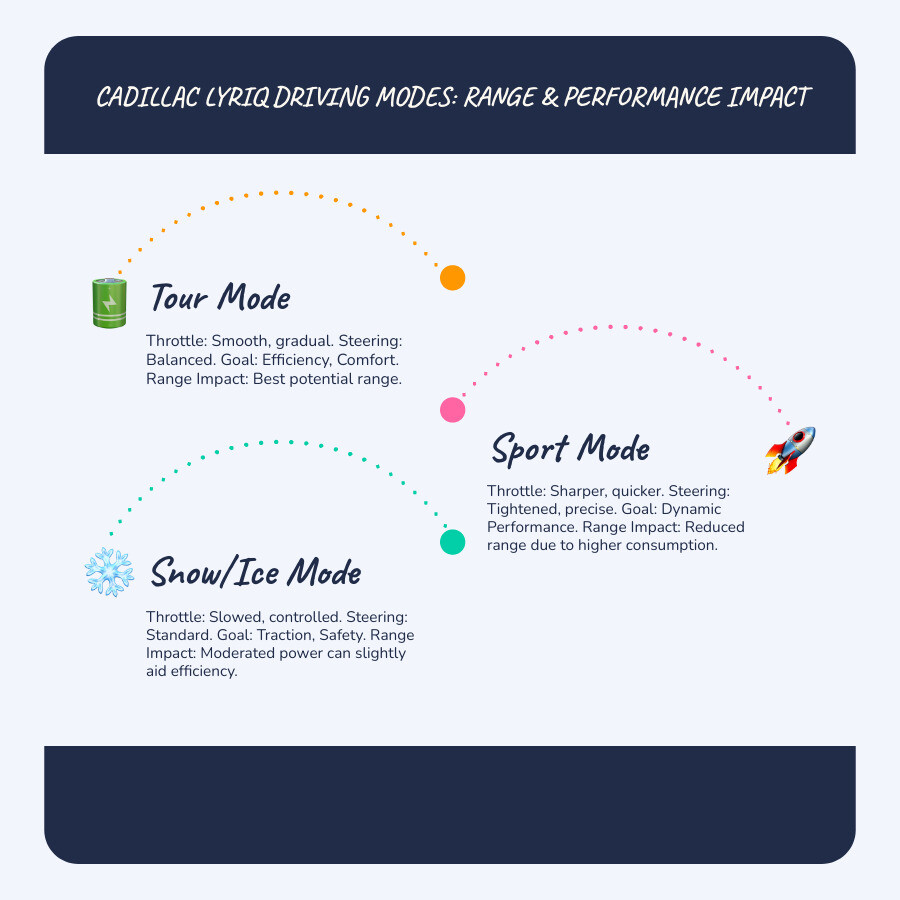
Let’s visualize how these primary modes stack up in terms of their impact on key driving characteristics and, crucially, our estimated range:
How driving modes directly impact your real-world range
The difference in real-world range between modes stems from how each setting manipulates the Lyriq’s energy utilization and power delivery. When we select a mode, we’re essentially instructing the vehicle’s sophisticated control systems to behave in a certain way, which directly influences how much electricity is drawn from the 102 kWh Ultium battery.
For instance, in Tour Mode, the conservative power delivery means that the Lyriq will deliver power smoothly and gradually. This avoids sudden, high-power demands on the battery, which are inherently less efficient. Think of it like sipping a drink versus chugging it – sipping (Tour Mode) makes it last longer. This leads to optimal efficiency and allows us to achieve the best possible range.
Sport Mode, on the other hand, is all about aggressive power delivery. When we press the accelerator, the system is tuned to provide a much quicker and more substantial surge of power. This sharper acceleration, while exhilarating, requires a significant and immediate draw of energy from the battery. This increased power demand translates directly into higher energy consumption and, therefore, a reduced real-world range. The exhilaration comes with a cost in miles.
Even Snow/Ice Mode, while primarily safety-focused, impacts battery usage. By slowing acceleration and torque response, it inadvertently reduces peak power demands, which can lead to slightly better efficiency in those conditions. It’s a subtle effect, but every bit counts when navigating challenging environments.
Does selecting a particular driving mode change the battery’s inherent capacity?
This is a common misconception, and it’s important to clarify: no, selecting a particular driving mode does not change the battery’s inherent capacity in the Cadillac Lyriq.
The Lyriq is equipped with a robust 102 kWh battery. This capacity is a physical attribute of the battery pack itself and remains constant regardless of which driving mode we select. What the driving modes do alter is how that 102 kWh of energy is used for propulsion and other vehicle functions.
Imagine our Lyriq’s battery as a full tank of gas. Choosing Sport Mode is like having a heavy foot on the accelerator, burning through that fuel faster. Tour Mode is like driving conservatively, making that same tank of fuel last longer. The tank’s size (battery capacity) doesn’t change; only the rate at which we consume its contents does.
The adjustments made in each mode—such as throttle response, regenerative braking intensity, and even the power supplied to ancillary systems like climate control (to a lesser extent)—all influence the rate of energy consumption. So, while our dashboard range estimate will fluctuate based on the mode chosen and our driving style, the underlying battery capacity remains a solid 102 kWh.
The Tech Behind the Modes: How Adjustments Impact Efficiency
Beneath the Lyriq’s sleek exterior lies a sophisticated electric powertrain, built on the Ultium Platform, that intelligently manages power. The driving modes leverage this technology to make precise adjustments that profoundly affect efficiency and range. It’s not just about how fast we go, but how smartly the vehicle uses its power.
How throttle response and power delivery affect battery usage
The throttle response, or how the vehicle reacts to our foot on the accelerator pedal, is one of the most direct ways driving modes influence battery usage. Each mode employs a different “pedal map” and acceleration curve.
- Sport Mode: This mode features a highly sensitive pedal map. Even a slight press of the accelerator results in a significant surge of power. This aggressive power output management means the motors are drawing more current from the battery more quickly, leading to rapid acceleration but also rapid battery depletion. It’s designed for immediate, thrilling response.
- Tour Mode: In contrast, Tour Mode uses a smoother pedal map. The acceleration curve is more gradual, meaning that even if we press the pedal with the same force as in Sport Mode, the Lyriq will deliver power more gently. This smoothness in power delivery reduces the peak current draw from the battery, making it much more energy-efficient for everyday driving.
- Snow/Ice Mode: This mode takes smoothness to an even higher level, specifically to prevent wheel spin. The pedal map is adjusted to be very conservative, significantly slowing the acceleration and torque response. This controlled power output is crucial for traction on slippery surfaces and inherently minimizes sudden, large power demands, contributing to efficiency in those conditions.
Essentially, the more immediate and aggressive the power delivery, the more energy the battery expends in a shorter amount of time. Understanding this helps us choose the right mode for the right situation, balancing our desire for performance with our need for range.
The role of regenerative braking and One-Pedal Driving
Regenerative braking is a cornerstone of EV efficiency, and the Lyriq employs it brilliantly, especially through features like Regen On Demand and One-Pedal Driving. This technology captures kinetic energy that would otherwise be lost as heat during deceleration and converts it back into electricity, which is then stored in the battery. It’s like giving our battery a little top-up every time we slow down.
- Regen On Demand: The Lyriq features a paddle on the steering wheel that allows us to manually engage and control the intensity of regenerative braking. When we pull this paddle, the vehicle rapidly decelerates, and a significant amount of energy is recovered. This is incredibly useful for extending range, especially in stop-and-go traffic or when approaching a downhill slope.
- One-Pedal Driving: This feature takes regenerative braking to the next level. When activated, we can largely control the vehicle’s speed using only the accelerator pedal. Lifting off the pedal initiates regenerative braking, slowing the vehicle down, potentially even to a complete stop, without needing to touch the brake pedal. This maximizes energy capture during deceleration, making it a highly efficient way to drive, particularly in urban environments like Brooklyn or Manhattan.
While the primary driving modes (Tour, Sport, Snow/Ice) primarily adjust propulsion, the intensity of regenerative braking can also be influenced by our chosen mode or customized through My Mode. A more aggressive regenerative braking setting, whether through One-Pedal Driving or frequent use of Regen On Demand, means more energy is recovered, directly contributing to extending our range. This is a critical component of the Lyriq’s overall efficiency strategy. For a deeper dive into the technical specifications, including braking systems, we can always refer to the Official LYRIQ Specifications.
Beyond Driving Modes: Other Key Factors Affecting Lyriq’s Range
While selecting the right driving mode is crucial for optimizing our Lyriq’s range, it’s just one piece of the puzzle. Several other significant factors play a role in how far we can travel on a single charge. Understanding these elements allows us to be even smarter about our energy consumption, especially when planning those longer excursions upstate or a weekend getaway.
The Impact of Climate Control and Cabin Preconditioning
One of the biggest silent energy consumers in any EV is the climate control system. Keeping us toasty in winter or cool in summer requires a considerable amount of power from the battery.
- HVAC System Energy Draw: Heating the cabin, in particular, can be quite energy-intensive. Traditional resistive heaters draw a lot of power. However, the Lyriq, built on the Ultium Platform, benefits from an integrated heat pump system for efficient cabin warming. Heat pumps are far more efficient than resistive heaters as they transfer heat rather than generating it, significantly reducing the energy required. Even so, running the HVAC at extreme settings will impact range.
- Heated Seats and Steering Wheel: For optimal efficiency and comfort, we should prioritize using the heated seats and heated steering wheel. These features directly warm us, the occupants, rather than trying to heat the entire cabin volume. This targeted heating is much more energy-efficient and can extend our range by several kilometers per trip, allowing us to maintain a slightly lower cabin temperature without sacrificing comfort.
- Preconditioning: This is a game-changer, especially during the colder months in New York. Preconditioning involves warming (or cooling) the battery and cabin before we start driving, ideally while the Lyriq is still plugged into a charger. When plugged in, the vehicle uses grid power for this process, preserving the battery’s charge for actual driving. Preconditioning brings the battery to its optimal operating temperature, which is crucial for efficiency and charging speed, and ensures a comfortable cabin from the get-go. Research suggests that preconditioning can preserve 15-25 km of range that would otherwise be consumed warming a cold battery and cabin. It’s an easy habit to adopt for better winter range.
How External Temperature Affects Battery Performance
External temperature is perhaps the single largest external factor influencing EV range. Lithium-ion batteries, like the one in our Lyriq, are less efficient in cold weather.
- Winter Range Reduction: We can generally expect a noticeable reduction in range during colder months. Industry data indicates that winter conditions typically reduce EV ranges by 20-40% depending on temperature severity, driving habits, and the use of climate control. This means a Lyriq with a fantastic summer range might see a significant drop when navigating a frosty New York winter.
- Cold Battery Chemistry: In low temperatures, the chemical reactions within the battery slow down, making it less efficient at both delivering and accepting charge. This leads to higher internal resistance, meaning more energy is wasted as heat within the battery itself.
- Thermal Management System: The Lyriq’s Ultium battery system incorporates advanced thermal management technology, including liquid cooling and heating, and insulated battery enclosures. This system works hard to keep the battery within its optimal operating temperature range, even in extreme cold. While it helps mitigate the effects, it cannot entirely eliminate the impact of very cold ambient temperatures.
- Summer Range Optimization: Conversely, in warmer, ideal temperatures, the battery performs at its peak efficiency, allowing us to achieve or even exceed the EPA-estimated range figures.
To counteract the effects of cold, besides preconditioning, parking our Lyriq in a garage whenever possible can help keep the battery warmer, reducing the energy needed to bring it up to optimal temperature. Planning our charging around our routine, such as overnight charging at home, also ensures the battery is warm and ready to go when we are.
Frequently Asked Questions about Lyriq Driving Modes and Range
We know you have questions, and we’re here to provide clear, concise answers to some of the most common queries about the Cadillac Lyriq’s driving modes and their impact on range.
Which Cadillac Lyriq driving mode offers the best range?
Tour mode is designed to be the most efficient for everyday driving, offering the best potential range by providing smooth, conservative power delivery and comfortable ride tuning. It minimizes aggressive power draws, maximizing how far the battery can take you.
How much does Sport mode affect the Lyriq’s range?
Sport mode prioritizes acceleration and dynamic performance, which uses more battery power. It delivers sharper throttle response and more aggressive motor calibration. While exact figures vary significantly with individual driving style, Sport mode consistently reduces range compared to Tour mode. This is the trade-off for a more exhilarating driving experience.
What is the official EPA-estimated range of the Cadillac Lyriq?
The EPA-estimated range for the Cadillac Lyriq varies slightly depending on the powertrain configuration. The single-motor RWD models have an impressive EPA-estimated standard range of up to 326 miles. The dual-motor AWD models, while offering improved traction and performance, have an EPA-estimated range of up to 319 miles. These figures represent optimal conditions and can be influenced by driving modes, external temperature, and driving habits.
Conclusion: Driving Smarter in Your Lyriq
We’ve journeyed through the intricacies of the Cadillac Lyriq’s driving modes and their tangible effects on range and battery usage. From the efficiency-focused Tour Mode to the performance-driven Sport Mode, and the customizable My Mode, it’s clear that our choices behind the wheel have a direct impact on our electric SUV’s capabilities.
Key takeaways:
- Modes matter: Each driving mode adjusts vehicle parameters like throttle response, steering, and power delivery, directly influencing energy consumption.
- Efficiency vs. Performance: Tour Mode is our friend for maximizing range, while Sport Mode sacrifices miles for smiles.
- Battery capacity is constant: Driving modes alter how energy is used, not the battery’s inherent 102 kWh capacity.
- Beyond modes: External temperature, climate control usage, and preconditioning are critical factors in real-world range.
- Regenerative braking is key: Utilizing features like One-Pedal Driving and Regen On Demand helps recover energy and extend range.
For us at Edible Brooklyn, understanding these nuances means more confident drives to our favorite local eateries, seamless commutes through the city, and worry-free weekend escapes. By making informed choices about our driving mode and being mindful of other factors, we can significantly influence our Lyriq’s range. It’s about finding that perfect balance between enjoying the Lyriq’s luxurious performance and being efficient stewards of its electric power.
Now that we know how to maximize our Lyriq’s range, we can explore further and longer, finding new culinary delights and experiences throughout New York. Discover the best restaurants to drive to in your Lyriq and start on your next delicious adventure.
