


What It Means to Complete the Square (And Why It Matters)
How to complete the square is one of the most useful algebra skills you can learn. Here’s the quick version:
- Move the constant to the right side of the equation
- Take half the x-coefficient, then square it: (b/2)2
- Add that number to both sides to keep the equation balanced
- Rewrite the left side as a perfect square: (x + b/2)2
That’s it. Four steps.
Completing the square lets you rewrite any quadratic expression like x2 + bx + c into a cleaner form: (x + p)2 + q. This “vertex form” makes it easy to solve equations, find the highest or lowest point of a curve, and even derive the quadratic formula itself.
The method is ancient – mathematicians in Old Babylonia were using it as far back as 1800 BCE. Later, the Persian mathematician Al-Khwarizmi formalized it in his landmark algebraic treatise. Today, it’s a core skill in algebra classes worldwide.
Why learn it if you already have the quadratic formula? Because completing the square gives you insight the formula doesn’t. It shows you why the formula works – and it reveals the shape and position of a parabola without graphing a single point.
Whether you’re solving a quadratic that won’t factor neatly, or trying to find the turning point of a curve, this method has you covered.
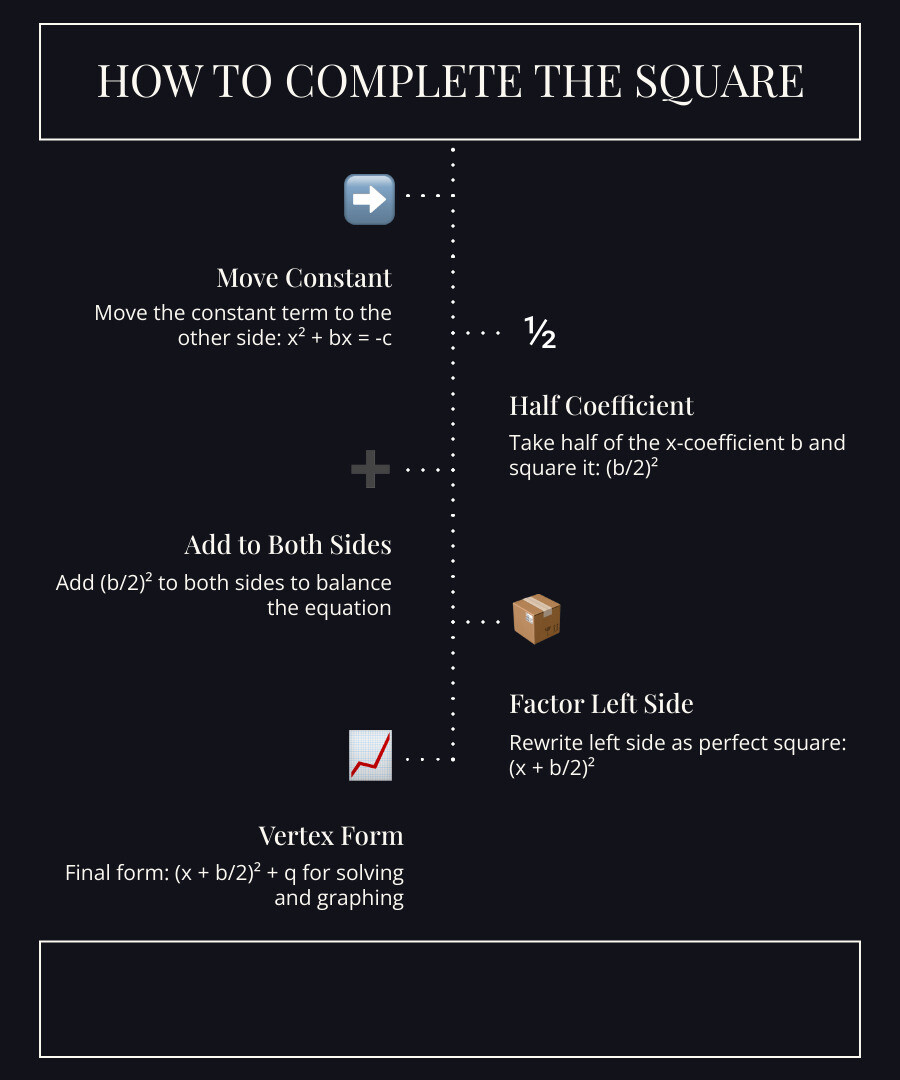
How to complete the square terms explained:
How to Complete the Square for Beginners
When we first encounter quadratic equations in our Brooklyn or Manhattan classrooms, they often look like a jumble of letters and numbers. But at its heart, how to complete the square is about creating a “perfect square trinomial.”
Think of it like baking a perfect sourdough loaf in a New Paltz kitchen; you need the right proportions to get that beautiful, symmetrical shape. In algebra, a perfect square trinomial is an expression that factors into two identical binomials, like $(x + 3)(x + 3)$, which we write as $(x + 3)^2$.
For beginners, we start with a “monic quadratic.” This is just a fancy way of saying the coefficient (the number in front) of the $x^2$ term is 1. If you see $x^2 + 6x + 5$, that’s monic. If you see $3x^2$, we have a little more work to do later.
To get started, we need to identify our terms:
- Monic quadratic: An expression where the $x^2$ term stands alone (coefficient is 1).
- Linear coefficient (b): The number in front of the $x$.
- Constant term (c): The number without a variable.
If you prefer a visual walkthrough, check out this Video tutorial on basic steps.
Step 1: Isolate the Variable Terms
The first thing we do is clear the workspace. If we have an equation in standard form, like $x^2 + 6x – 7 = 0$, we want to get the $x$ terms by themselves.
We move the constant term (the $-7$) to the right side of the equation by adding 7 to both sides. Now we have:
$x^2 + 6x = 7$
This leaves a “gap” on the left side where we are going to place our “magic number” to complete the square. Keeping the equation balanced is the golden rule of algebra—whatever we do to the left, we must do to the right.
Step 2: Calculate the Magic Number
This is where the actual “completing” happens. We look at the linear coefficient, which is the number in front of the $x$. In our example, that number is 6.
The formula for the magic number is $(b/2)^2$.
- Take half of the coefficient: $6 / 2 = 3$.
- Square that result: $3^2 = 9$.
Our magic number is 9. This is the missing piece of the puzzle that turns our expression into a perfect square.
Step 3: Balance the Equation
Now, we add that magic number to both sides of our equation. This is the addition property of equality in action. If we only added it to the left, our equation would tip over like an unbalanced scale at a Catskills farmers’ market.
$x^2 + 6x + 9 = 7 + 9$
$x^2 + 6x + 9 = 16$
Step 4: Factor into a Binomial Square
The left side is now a perfect square trinomial. We can factor $x^2 + 6x + 9$ into $(x + 3)(x + 3)$, or simply $(x + 3)^2$.
Notice a shortcut: the number inside the parentheses ($+3$) is always exactly half of the original $x$-coefficient ($+6$).
Our finished equation is:
$(x + 3)^2 = 16$
From here, solving for $x$ is a breeze. We just take the square root of both sides, remembering to use the plus-or-minus symbol:
$x + 3 = \pm 4$
This gives us two solutions:
$x + 3 = 4 \rightarrow x = 1$
$x + 3 = -4 \rightarrow x = -7$
Mastering the Method When the Coefficient is Not 1
Life in New York isn’t always simple, and neither are quadratic equations. Sometimes the leading coefficient (the number in front of $x^2$) is not 1. When we see something like $2x^2 + 8x – 10 = 0$, we can’t jump straight to the magic number. We have to deal with that 2 first.
Historically, this method has been refined over thousands of years to handle these “non-monic” cases. You can read more about the Historical context of the method to see how ancient scholars navigated these complexities.
Factoring Out the Leading Coefficient
The most reliable way to handle a leading coefficient is to factor it out of the $x$ terms. Let’s look at $2x^2 + 12x + 10 = 0$.
- First, move the constant: $2x^2 + 12x = -10$.
- Factor the 2 out of the left side: $2(x^2 + 6x) = -10$.
- Now, complete the square inside the parentheses. Half of 6 is 3, and $3^2$ is 9.
- Add 9 inside the parentheses: $2(x^2 + 6x + 9)$.
Wait! Here is the trickiest part. By adding 9 inside a set of parentheses that is being multiplied by 2, we didn’t actually add 9 to the left side—we added $2 \times 9$, which is 18. To keep the equation balanced, we must add 18 to the right side:
$2(x^2 + 6x + 9) = -10 + 18$
$2(x + 3)^2 = 8$
Now you can divide by 2 and solve as usual!
How to Complete the Square with Fractions
Sometimes the $x$-coefficient is an odd number, like in $x^2 + 3x + 1 = 0$. When we take half of 3, we get $3/2$ or 1.5.
We always recommend using fractions rather than decimals. It makes squaring easier and keeps your final answers in exact form.
- Half of 3 is $3/2$.
- $(3/2)^2$ is $9/4$.
- Add $9/4$ to both sides.
Working with rational numbers and common denominators might feel like navigating a crowded L-train at rush hour, but it ensures your mathematical precision is top-notch.
Why This Method is a Mathematical Powerhouse
We often get asked why we bother with this when the Quadratic Formula exists. The truth is, how to complete the square is the “Swiss Army Knife” of algebra. It doesn’t just solve for $x$; it tells you the story of the equation.
| Method | Best For… | What it Reveals |
|---|---|---|
| Factoring | Simple equations with whole numbers | Roots/Intersects |
| Completing the Square | Finding the vertex, deriving formulas | The “Turning Point” and Shape |
| Quadratic Formula | Messy equations with big decimals | Only the Roots |
For a deeper dive into these comparisons, you can explore Mathematical definitions and solutions.
Finding the Vertex of a Parabola
In food and lifestyle at Edible Brooklyn, we appreciate the beauty of a perfect curve—whether it’s the rim of a hand-thrown ceramic bowl or the trajectory of a parabola.
When you complete the square, you put the equation into vertex form: $y = a(x – h)^2 + k$.
In this form, the point $(h, k)$ is the vertex (the turning point) of the parabola.
- If $a$ is positive, the vertex is the minimum (the bottom of the valley).
- If $a$ is negative, the vertex is the maximum (the top of the hill).
This is incredibly useful for graphing. Instead of plotting dozens of points, you just find the vertex and the axis of symmetry, and you’re halfway there.
Deriving the Quadratic Formula
Did you know the Quadratic Formula isn’t just something a mathematician made up to be difficult? It is actually derived entirely by completing the square on the general form $ax^2 + bx + c = 0$.
By following the four steps we outlined—dividing by $a$, moving $c/a$, adding the magic number, and taking the square root—you eventually end up with $x = \frac{-b \pm \sqrt{b^2 – 4ac}}{2a}$. Completing the square is the engine that powers the formula.
Common Mistakes to Avoid
Even the most seasoned Brooklynites make mistakes when things get hectic. In algebra, small slips can lead to big errors.
- Forgetting the “Balance”: The most common mistake is adding $(b/2)^2$ to the left side but forgetting to add it to the right.
- Sign Errors: If your $x$-term is negative, like $x^2 – 8x$, your binomial square must also be negative: $(x – 4)^2$.
- The Plus-Minus Symbol: When you take the square root of both sides, you must include the $\pm$. Quadratic equations usually have two solutions, and you’ll lose one if you forget this.
- Parentheses Placement: When factoring out a leading coefficient, the magic number is multiplied by that coefficient before you add it to the right side.
For more practice on these pitfalls, see these Step-by-step worked examples.
Frequently Asked Questions about Completing the Square
How to complete the square when the x-coefficient is odd?
As we mentioned, stick with fractions! If your coefficient is 5, half is $5/2$, and the square is $25/4$. Adding $25/4$ to both sides might look messy, but it keeps your results in “exact form,” which math teachers (and scientists in New York’s tech hubs) prefer over rounded decimals.
What is the difference between vertex form and standard form?
Standard form is $ax^2 + bx + c$. It’s great for seeing the y-intercept (which is just $c$). Vertex form is $a(x-h)^2 + k$. It’s superior for graphing because it tells you exactly where the parabola turns $(h, k)$ and how it has been transformed (shifted left, right, up, or down).
Can this method handle complex or imaginary roots?
Yes! That is one of its strengths. If you complete the square and end up with something like $(x+2)^2 = -9$, you can’t take the square root of a negative number using real numbers. However, you can use imaginary numbers ($i$). In this case, $x+2 = \pm 3i$, so $x = -2 \pm 3i$. This is essential for advanced physics and engineering.
Conclusion
At Edible Brooklyn, we believe that whether you’re perfecting a recipe or mastering a mathematical proof, the process matters. Learning how to complete the square is more than just an academic exercise; it’s about developing the analytical thinking and problem-solving skills that help us navigate the complexities of life in New York.
The discipline required to balance an equation is the same discipline required to balance flavors in a complex reduction. Once you’ve mastered these four simple steps, you’ll find that many other “hard” math topics start to fall into place.
Ready to reward your brain after all that hard work? Why not Explore Brooklyn’s best restaurants and find a spot to relax? Whether you’re in Manhattan or the Catskills, there’s always something delicious waiting for you. Happy calculating!
