

“Think of an oyster bar. Imagine the stools you’re sitting on are made of oyster shells,” says Kendal Mitchell. “Or, you’re going to a Japanese restaurant, and the kombu used to make the dashi is used to make the lamps.”
This is Kendal Mitchell’s world, where food, design, and biomaterials all become one; where dining out becomes a polysensual experience; where discarded food waste comes back to the spatial experience of dining.
When she talks about the process, you can see it. Youthful, bright-eyed, and sitting with such impeccable posture and poise, she seems oblivious to the enormity of the task in front of her: changing how we experience food.
The circular nature of Mitchell’s art translates directly to her career path. Her early interests in food started at Deerfield Academy, a boarding school in Massachusetts where she attended on full scholarship. “You’re in this very wealthy school, but you’re also in an area in Massachusetts that’s also dealing with lack of access to healthy foods,” Mitchell says.
This contradiction served as an introduction to thinking about food systems critically. She joined clubs like Leaders Eating Ethical Foods (LEEF), where she explored food justice issues associated with the development of monoculture systems in the United States and around the world.
During her senior year of high school Mitchell successfully applied to study abroad at an agroecology and food program in Italy. Her growing understanding of the nutritional and environmental aspects of food systems began to merge with the culinary world.
“You’re eating persimmons in the fall, picking plums and grapes. You’re having pumpkin ravioli. Later in the winter, you’re foraging mushrooms. There’s a certain connection with the planet and flow of the seasons that I’d never gotten to experience, especially living in the United States,” Mitchell says. This experience was interrupted by the Covid pandemic, but her passion for regenerative food systems had been lit.

For the past four years, the multidisciplinary artist, chef, and biomaterials researcher has cut her teeth in the restaurant industry, from host, to maître d’, to executive chef—all while being a full-time student at Parsons School of Design. An academic career that began with photography and environmental studies—capturing and styling Misty Copeland by day, and constructing elaborate tablescapes with Woldy Reyes by night—has evolved to a major in food studies, with a focus on biomaterials research.
All of the biopolymers and binders Mitchell learned how to make in the classroom were the same ones she used in her kitchen, like agar and gelatin. “When I started to take these [biomaterials] classes, I realized, ‘Oh, these are recipes!’ I had this amazing throughline where I was, like, ‘Making biomaterials is just like making food,’” Mitchell says.
Seeing first-hand the level of food waste that comes with food preparation, Mitchell asked herself a question that would become fundamental to her ethos and growing combined body of work: “How could I take these parts of food and reintegrate them into these experiences to change the way people think about what is valuable?” she says.
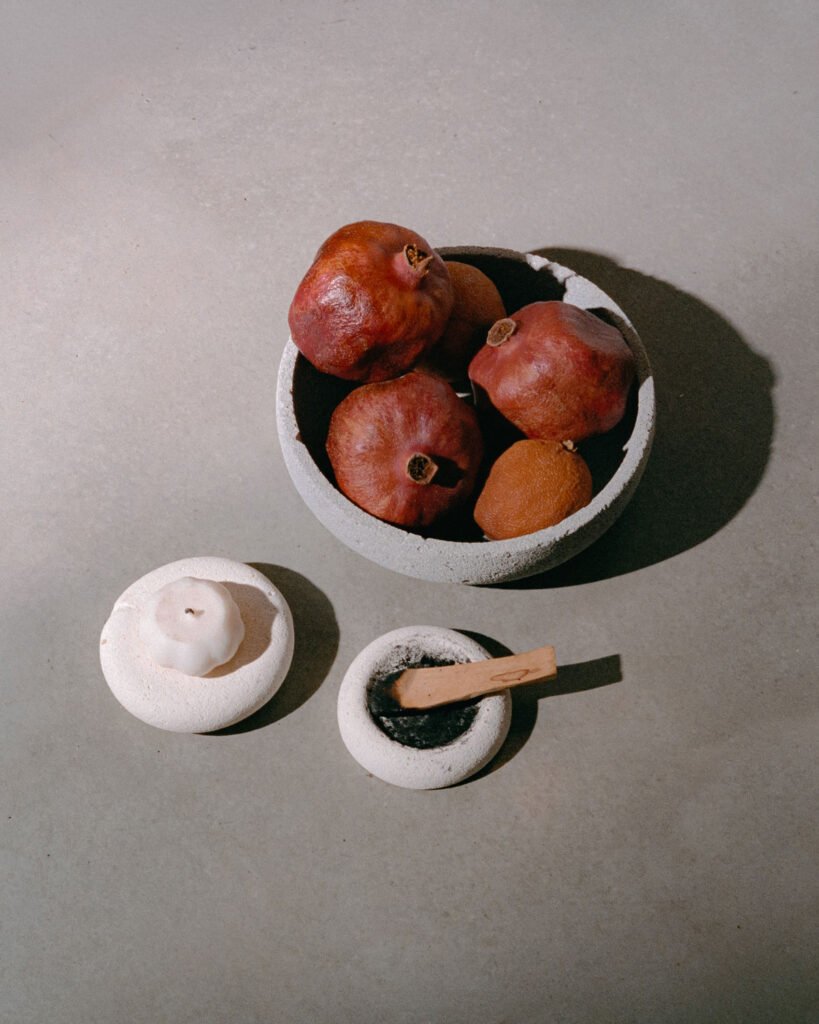
Her Instagram series and soon-to-be cookbook, Bringing Food Waste Back to the Table, begins to answer this. Half culinary recipes and half biomaterials experiments, it makes Mitchell’s work enticing and accessible for gourmets and geeks alike.
“How can I develop interventions for wasteful systems in a way that makes me happy, in a way that’s fun, and in a way that can be for other people. These projects and experiments don’t have to be limited to a lab; you can do them in your kitchen,” Mitchell says. Whether it be her picture-perfect script on a menu made of edamame paper, or a delicate tart resting on an eggshell ceramic plate, Mitchell’s Instagram series gives viewers a glimpse of her playful process.
At 22 years old, Mitchell’s journey is only beginning. “I want to be a great chef and a great designer. I want to help teach people. I want it to be accessible, so I want to develop a space or seek out spaces where I can host workshops and courses,” she says. A world where we enjoy edamame ice cream by kombu lamplight is closer than we can imagine, and one can’t help but anticipate its arrival.
Today, Mitchell is a fish specialist at Osakana, a sushi bar in the East Village. The ingredients she works with regularly serve as a major inspiration for her design process. The kombu lamp was born from Osakana’s rice vinegar recipe, where kombu serves as the base. While brainstorming how to reutilize kombu, she pinpointed its leatherlike properties and oceanic scent, making it perfect for a delicate dashi and moody lamp.
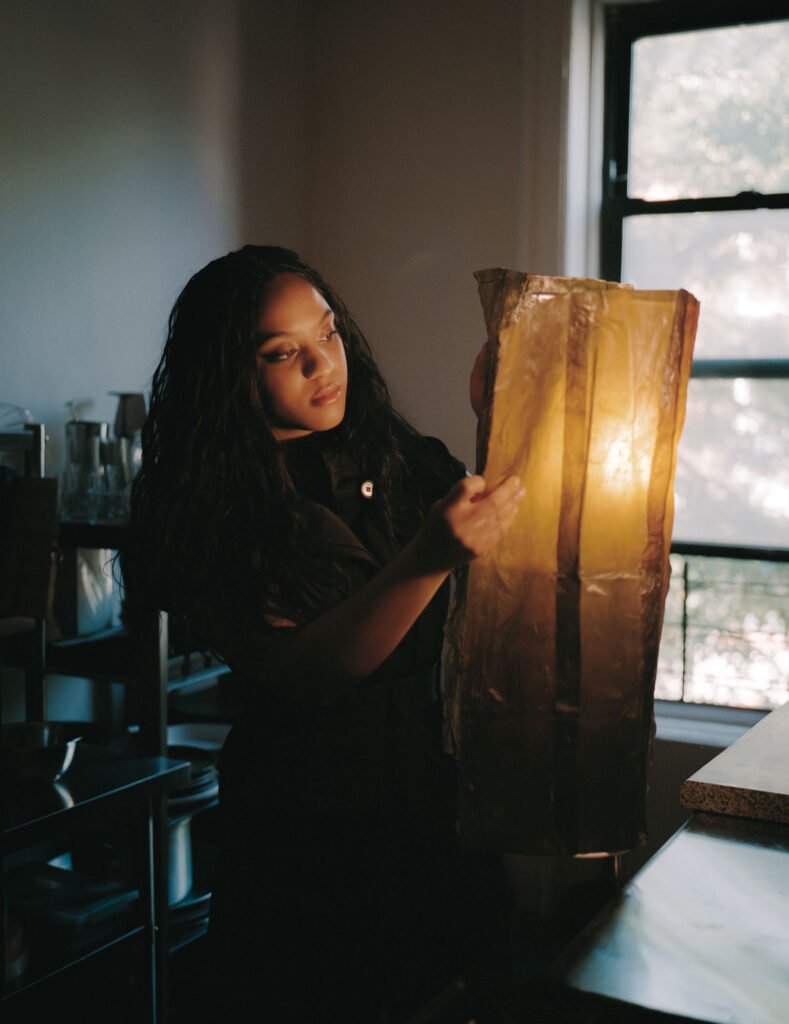
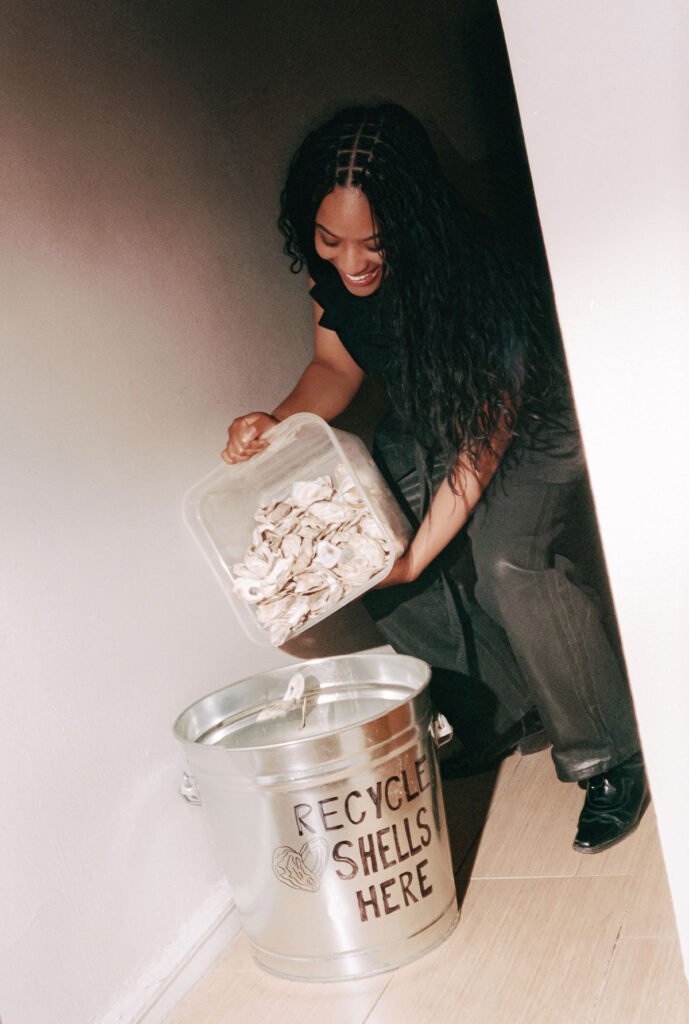
“I normally don’t work with fish, but I wanted to seek out a place that specializes in fish butchery. I do want to have that skill set and learn as much as possible so I can be the chef that I want to be,” she says. Her shifts start early, so you can find her at La Cabra grabbing a pastry before a long day of mastering her sashimi, maki, and nigiri skills. When Mitchell leaves work, she’ll play catch up for her book club, Literary Appetites; experiment with new zero-waste dishes; or process mountains of eggshells and oyster shells for upcoming projects.
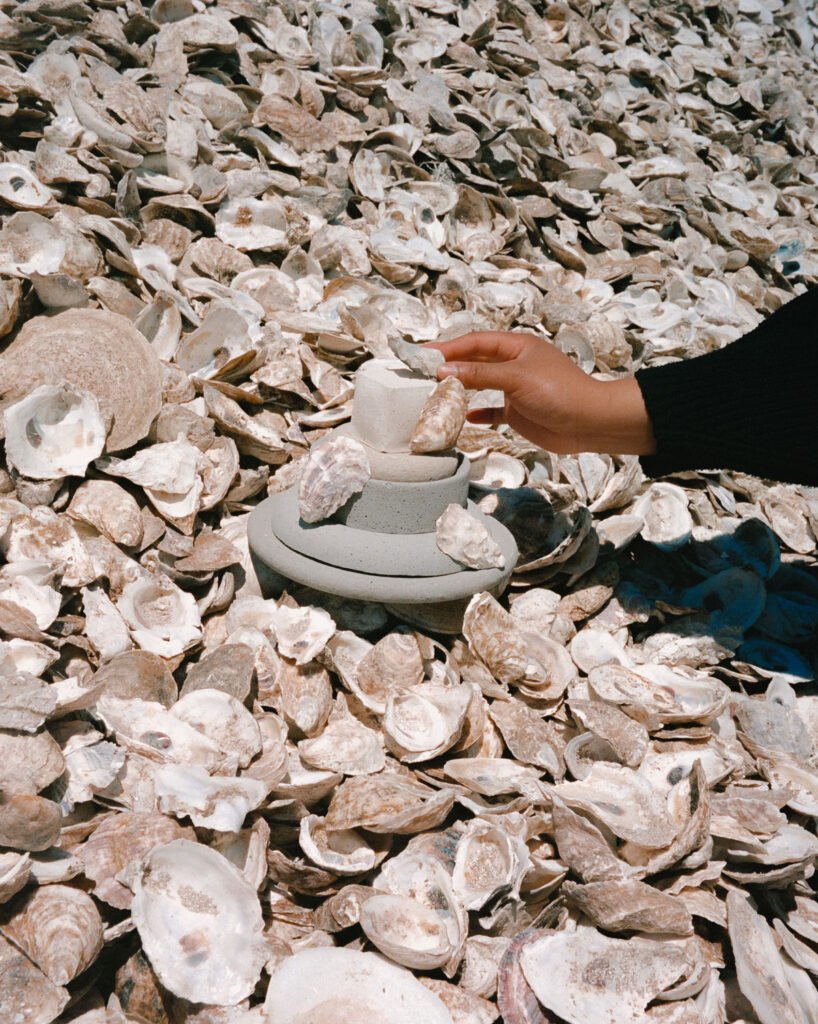
As we discuss her creations, she holds up part of her thesis project, a plateware set made of oyster shells. The structural integrity of the piece shines through the LoFi nature of a late-night Google Meets call between two 20-somethings. She’s donning her signature black boho braids with bold eyeliner to match—despite recovering from a cold. I’m unsure if I am more amazed by the precision of her eyeliner or the small plate that looks like it could be carved from the moon itself.
The solution Mitchell presents is no less than universal: The things we categorize as trash are viable materials for design that can be reintegrated into our day-to-day lives. Her goal is to work with other restaurants and chefs to design materials from food waste, creating a stronger relationship between the food that comes out of the kitchen and the interior space: “How do I put these things in people’s spaces?” she says, “and subconsciously change their thinking.”